Coaxial RC Helicopters
They Still Have A Place In Our Hobby
by John Salt - Last Updated November 2023
I still think micro coaxial RC helicopters remain to be one of the most amazing and fun products to have hit the RC market in years. Yes, they have been overshadowed by quad-rotors and fixed pitch single rotor helicopters with electronic self-level stabilization & altitude hold as the best entry level helicopters for beginners; but coaxials are still introducing many people to this wonderful hobby with low cost toy versions.
The very popular tiny palm sized SYMA S100 Mini for example is one of the smallest and easiest flying coaxial toy helicopters on the market; it always gets great reviews!
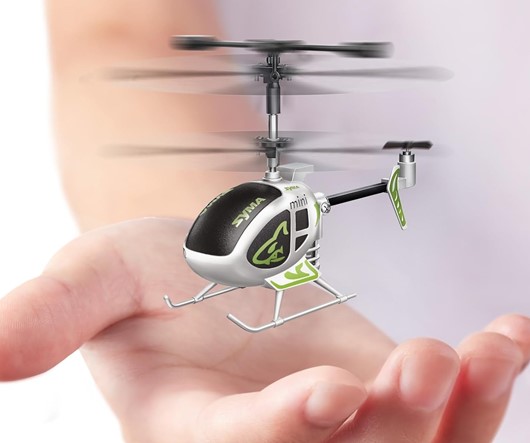
The cost is low, the fun is high... They work well for just about every age group and ability. They are the perfect introduction for first time flyers to the RC hobby as I've already mentioned on my "RC Helicopters For Beginners & Kids" page; yet experienced RC heli and airplane pilots continue to find them enjoyable for some easy going indoor flying when we just need a bit of a "flying fix" and can't venture outside.
Even though it was discontinued a good number of years ago, I still very much enjoy flying my Blade CX3 indoors during the winter months for a little bit of "scale" fun. In the hundreds of flights I have had with it, it continues to work and fly so well.
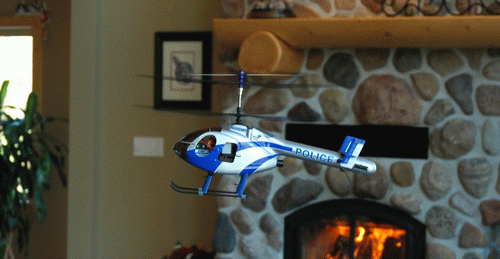 Flying My Coaxial Scale MD520N Indoors On A Cold Winter Sunday Morning - Better Than A Cup Of Coffee :-)
If you are interested in RC helicopters but are a little intimidated by the complexity of single rotor fixed pitch hobby grade helis; Coaxials are a good solution.
If your main reason for thinking of getting into the hobby is because of your fascination with helicopters in general, micro coaxials are the obvious choice over micro quad-rotors that look nothing like a conventional helicopter.
Even though coaxials are easy to fly, many of the skills you learn on a hobby grade coaxial RC helicopter are somewhat transferable to single rotor hobby grade RC helis. This holds especially true for understanding the control reversals when practicing nose in hovers .
What Makes Coaxial RC Helicopters So Special?
Simple, efficiency & stability!
Unlike a conventional single rotor helicopter that only has one main rotor and a tail rotor to counteract the torque produced, coaxial helicopters have two main rotors stacked on top of each other.
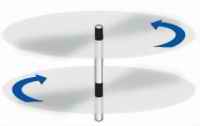
Having two rotors spinning in opposite directions at the exact same speed produces equal amounts of torque from both.
Since the torque is equal, but occurring in opposite directions, it essentially cancels out (a state of torque equilibrium), and the helicopter won't yaw (turn).
No additional energy is therefor needed to power a tail rotor to counter the torque giving improved efficiency; which on an electric powered RC helicopter equates to longer flight times.
Having two spinning main rotors also adds rotor mass which produces a significant gyroscopic effect that helps stabilize coaxial RC helicopters.
In short – no other mechanical design is as efficient or stable. Remember me saying on the home page that all helicopters are unstable? Well, coaxial’s break this rule - unless of course your coaxial heli encounters the infamous Toilet Bowl Effect .
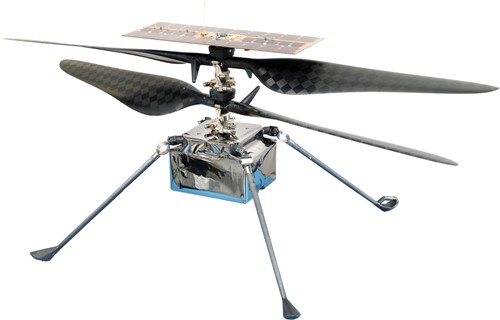 Nasa's Ingenuity Coaxial Mars Helicopter
It should therefor come as no surprise, NASA also decided to use the coaxial helicopter design for their very first Mars helicopter named the Ingenuity. Mars with an atmosphere 100 times thinner than Earth's, an efficient coaxial was the obvious choice.
How Do Coaxial RC Helicopters Work?
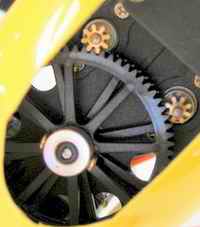
All micro coaxial RC helicopters work the same way. They have two separate electric motors that drive each rotor. You can see this in the picture to the right.
Each motor drives a main gear. You can’t see the upper gear that well in this photo because it is hidden by the lower gear, but you can easily see the two motor pinion gears (the small brass ones).
At any rate, these two main gears turn two main rotor shafts. The outside shaft that powers the lower rotor is hollow and the inner shaft that powers the upper rotor is spinning inside the lower hollow shaft – obviously in the opposite direction – pretty simple.
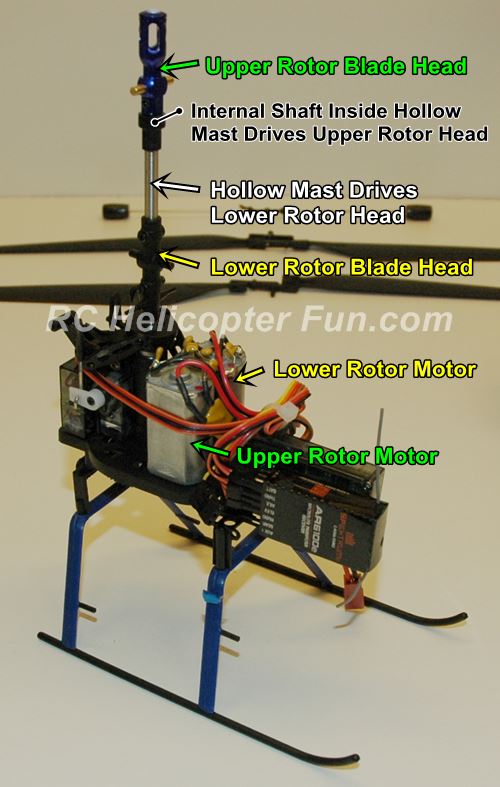 Coaxial RC Helicopter Mechanical Components
These two motors control both the lift of the helicopter by speeding up and slowing down. They also control the turning or yaw movement of the heli just like a tail rotor would on a single rotor helicopter. How?
If one rotor is slowed down a bit, and the other is sped up, the one that is turning faster will produce more reactive torque than the slow one and the heli will turn/yaw, just as if a tail rotor turn command was given.
This yaw movement is controlled by a special electronic mixing board that will seamlessly mix the speed of both the motors to allow the required turn rate while also making sure the overall lift remains the same.
Coaxial RC Helicopter Directional Control Methods
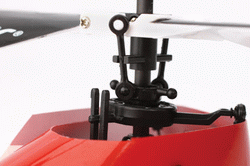 Blade mCX2 Swashplate On Lower Rotor
True Cyclic
Yes, some hobby grade micro coaxial RC helicopters have a swashplate meaning they have true cyclic directional control (forward, backward, left, right)
This is rare these days because they cost more to produce.
Moreover, with electronic stabilization & electronic altitude hold on some beginner fixed pitch single rotor helicopters being almost as stable and easy to fly as a coaxial (such as the C129), no manufacturers are offering coaxials with cyclic anymore.
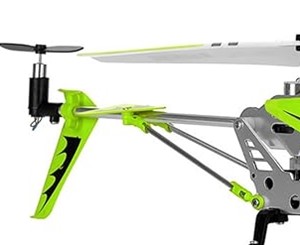 Horizontal Tail Fan Pitches Heli Forward & Backward
Horizontal Tail Fan Pitch Control
Most small coaxial RC helicopters use the horizontal tail fan method to pitch the heli slightly forward or backward by blowing the tail up (heli moves forward) or down (heli moves backward).
NOTE! This tail rotor is horizontal (blows air up and down) not vertical like most helicopter tail rotors that blow sideways to control yaw.
These little horizontal tail rotors do offer some directional control, but it's vague and slow at best. There is also no roll (left/right) movement control, only forward & backward.
Also forget about flying a coaxial RC helicopter with a horizontal tail rotor/fan if there is even a light breeze blowing. The tail fan simply can't provide enough directional control to cope with the slightest amount of wind.
Even cyclic control on a small fixed pitch coaxial RC helicopter isn't great outdoors in wind, but it can at least handle a slight breeze.
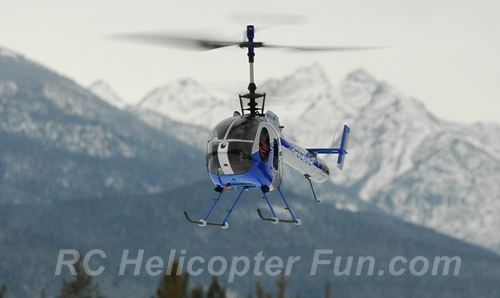 Coaxial RC Helicopter With True Cyclic Flying Outdoors In A Light Breeze
Coaxial RC Heli Recommendations
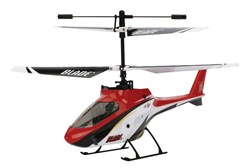 The Last Decent Micro Coaxial With True Cyclic Control
Blade's mCX2 electric micro coaxial helicopters was discontinued a few years ago but remaining stock can still be found. It remains my top coaxial choice for several reasons.
Main one being it was the last decent 4 channel micro coaxial RC helicopter on the market that used proper cyclic control.
It's fairly robust, looks good, had adequate parts support from most local hobby shops or online shops; it was obviously also super fun and easy to fly.
Here's my full write-up of this neat little 4 channel coaxial RC helicopter.

Next up would have to be the ever popular SYMA S107.
Like the Blade mCX2, the SYMA S107 has been around for many years and constantly gets good reviews and feedback from newbies and experienced RC helicopter enthusiasts alike.
Unlike the mCX2, the S107 is still readily available from many sources and replacement parts are easy to find and inexpensive.
The S107 doesn't use cyclic control however and relies on a horizontal tail fan to pitch it forward and backwards slightly. No it's not great control; but it's still a fun coaxial RC helicopter flying experience, and if you want a decent small collective pitch RC helicopter, this one is hard to beat. If you want something smaller however, the aforementioned SYMA S100 Mini might be a better match.
Just don't expect either of these SYMA coaxials to produce the same level of engagement or control precision that the Blade mCX, mCX2, CX2 and CX3 all gave us.
Coaxial Tandem Rotors
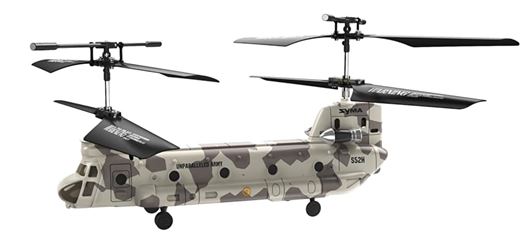
The SYMA S52H is a personal favorite and one I would definitily recommend, but not as your first RC heli. Get some practice on one of the previously mentioned coaxials first.
Like all scale RC helicopters, the little S52H is fairly fragile and won't handle much abuse from a newbie who is learning. After you learn the basics however on a standard micro coaxial heli, these tandems are a great next bird, and a total hoot to fly.
I've always been intrigued with tandem rotor coaxials and how they work using fore / aft rotor lift variation to induce forward/backward movement. It's simple, effective and mimics that wonderful tilt of the entire fuselage when transitioning from a hover to forward flight; just like the full size Boeing CH-47 Chinook.
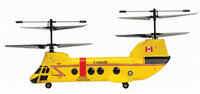 The mCX Tandem Rescue Was So Fun
For those that remember and loved Blade's mCX Tandem Rescue which was discontinued a number of years ago; the Syma S52H is very similar.
It's so nice to see a small and good quality coaxial tandem rotor RC helicopter being offered again. Just wish it was in that bright yellow Canadian SAR livery :)
Micro Coaxial vs Micro Quadrotor
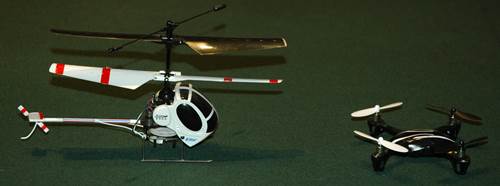 Micro Coaxial vs. Micro Quadrotor - Who's the winner?
I have been hearing a fair number of people stating micro coaxial RC helicopters are not going to be around for much longer because of micro quad-rotors.
I for one don't agree with that at all. Not because I dislike micro quads, I feel they are also a very good first time RC helicopter as well; but the one undeniable fact is they look nothing like a conventional helicopter.
I personally got into this hobby because I was always fascinated by real helicopters and I know many other people who continue to get into the hobby for the exact same reason. If you fall into that category yourself and want something simple and fun to fly, a micro coaxial RC heli still is, and will remain to be a good RC helicopter to start out on.
On the flip side of the coin; if you really don't care about the true helicopter looks or how they work, then I would agree; a micro quad rotor is probably the better route to go. If you want more information about this, again please take a peek at my RC Helicopters For Kids & Beginners page or to find out more about quad-rotors, feel free to take a peek at my quadrocopter page .
To conclude my little coaxial helicopter write-up, I can't resist showing this video of a full size single seat turbine powered coaxial helicopter. I can't think of many "big kids" who would not want this rascal parked in their garage.
As an Amazon Associate I earn from qualifying purchases.

Need Heli Help?
- Are you getting into the hobby and have no one to help you out?
- Are you feeling overwhelmed & confused?
- Are you tired of wasting time seeking partial and conflicting information?
- Is crashing due to not fully understanding helicopter setup turning you off the hobby?
- Are you simply ready to give up?
My RC Helicopter eBooks are here to help you with those exact problems.
Click Here For More Information

Click Here For More Information
Click Here For More Information
 Interested In RC Airplanes Too? Save Money With The Beginner's Combo Package
Recent Articles


-
OMPHobby RC Helicopters Let You Master The Skies
Apr 18, 24 07:21 PM
 Don't settle for anything less! OMPHobby RC Helicopters are built to last while taking your flying passion to a whole new level.
 -
Best Flybarless System In 2024 - Is There Such a Thing?
Apr 02, 24 09:08 PM
 Looking for the best flybarless system? Let's look at what's out there, pros & cons, features and pricing, to help you narrow your list.
 -
Learn How To Fly 3D Helicopter Aerobatics
Mar 15, 24 03:30 PM
 Want to learn how to fly 3D helicopter aerobatic maneuvers? Follow this skill building lesson plan to succeed.