The Best RC Helicopter is One That's Right For You.
by John Salt - Last Updated December 2025
Deciding on the best RC Helicopter can be a daunting task.
Your Experience, your Budget, the Size of Your Flying Area, Parts Availability & the Amount of Time & Passion you are willing to dedicate to your New Hobby are the main deciding factors.

Most RC helicopter advertisements are confusing with information and technical terms that only an experienced RC heli enthusiast would understand.
We'll go over these items, and explain their operation and limitations to help you make an informed RC helicopter choice for your needs or someone else's if you are thinking of purchasing an RC helicopter as a gift.
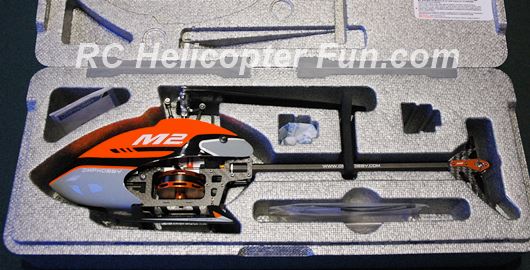
Yes - watching someone's eyes light up when they open the box to their new bird is worth every penny, but can be a real let down if it's a low quality product or is not suited to their individual needs.
RC Newbie Heli Time Saving Tip:
If you are specifically & quickly looking for the best RC helicopter for a beginner, child, or newbie, my Best RC Helicopter for Kids & Beginners page covers the more basic beginner questions & recommendations.
The following in-depth best RC helicopter info on the other hand is not quick. It's for those of you who seriously want to put the time and effort into the hobby and want to understand more about choosing the best RC helicopter; taking everything into account from size and type, to features to know about and ones to avoid.
My goal is to give you enough detailed information so you can make your own recommendations on what the best RC helicopter is for your own/others needs. Helping you avoid much of the subjective / paid influencer hype, marketing junk and AI slop, that more times than not will point beginners in the wrong direction.
I will however mention several RC helis that I feel are among the better birds, sizes, & brands that I would recommend as an instructor to friends & students. Let's get started...
Reading Past The "Best RC Helicopter" Marketing BS.
Any influencer or advertisement that is telling you "this
brand of heli is better than the others" or is stating something like
"this is the best & easiest RC helicopter for the beginner"; or offers up some obscure "Top 5 RC Helicopter List" is not being
truthful or sincere.
There are simply too many variables and compromises at play in this hobby and statements or lists like those are unrealistic, anecdotal, and in the case of AI slop - regurgitated and often wrong lacking any real world context or understanding of what it takes for a beginner to successfully get into this hobby.
They are generated by marketers, not RC helicopter enthusiasts.
- Why are they the best?
- What is the benefit to you as the consumer / customer?
- Is it a brand or model that will be obsolete in a year or two leaving you high and dry for parts support?
- Is local or at least regional parts availability important to you?
- Are you already really passionate about getting into the hobby, or is this just a fleeting interest?
- How much time do you have to dedicate to the hobby?
- Do you enjoy working with your hands; specifically on small mechanical devices?
- Where do you intend to fly?
- How do you intend to learn (self learn vs. instructor)?
- What's your budget?
- How good are your eyes?
These are all important questions to ask yourself when first getting into the hobby. Depending on the answers, a particular RC heli I or others like, you very well may end up disliking.
If there truly was a "best RC Helicopter" we would all be flying the same thing. That of course is not the case; all have pros, cons, and compromises.
Incidentally and since I get this question so often "what brand/s of RC helicopters do you fly"; my two main bands of choice are Align Helicopters & OMPHobby Helicopters. I purchase them with my own hard earned money just like you have to so they are true objective purchase decisions. Again, just because I like these two brands, doesn't mean you will as well; I'm only mentioning it because it's such a common question.
Anyway... A good hobby shop or supplier that knows their product, and wants to sincerely help you get into the hobby in a positive and successful way, should initially have just as many questions for you as you do for them based on those above points.
In short, they should first identify your needs & expectations -
not theirs.
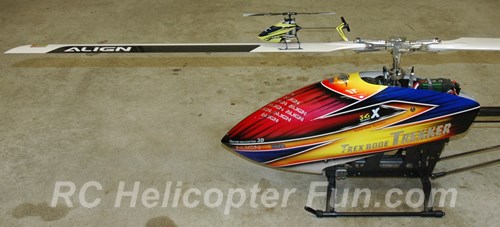 What Size Makes The Best RC Helicopter? Depends On Many Factors...
The Very First Question For You...
Do you want an easy to fly RC Heli with more or less instant fun & gratification out of the box, or are you ready to dive in head first by getting into collective pitch (also called 3D) RC helicopters and all the challenges and rewards that go along with them?
Not sure of the differences between these two avenues? My Getting Started With Radio Controlled Helicopters page covers all that so if you're a little foggy between the basic types of RC helicopters on the market - that page explains the differences in depth.
As a quick recap & overview from that page...
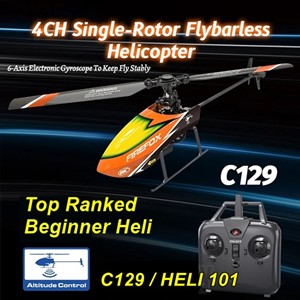
I mention first getting your feet slightly damp with an entry level Toy RC Helicopter (link takes you to my page discussing toy helicopters and what to look for in detail).
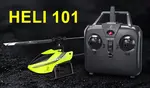
Micro hobby grade fixed pitch RC helicopters are another consideration if you want a bit more of a challenge and not get bored as fast. My current top recommendation is the C129 / Heli 101 & Eachine E129 (all the same helicopter with different brand names and canopy colors).
These are very good radio controlled helicopter options for your first introduction into the hobby. They are lower in cost, fairly easy to fly, teach control basics and offer more or less instant fun.
The down sides is they will get boring after a while or at least limiting in what you can do with them (especially the toy variety). They don't have the same rock solid fast flight characteristics that collective pitch RC helicopters have nor do they have the ability to fly inverted.
They are all rather small making it hard to see them when flying at any distance outdoors and forget about flying them in any sort of wind.
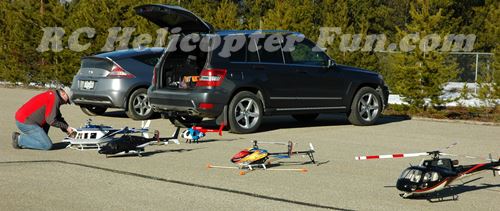 A Day Out At The Flying Field With RC Helicopters - This is the BEST!
This is where the more complex, interesting, and performance
minded collective pitch helicopters (also called CP or 3D), come into the mix.
If you are the sort of person looking for an immensely rewarding hobby, want the type of control that real full size helicopters have, don't mind learning all about the complexities associated with collective pitch RC helis, you enjoy a challenge and are willing to put in the time & practice required; collective pitch is for you!
In other words, you can already appreciate that successfully getting into collective pitch is more about the journey than the destination. It's a never ending learning curve in other words. Just like full size aviation where you are constantly honing your skills & knowledge.
Still with me? Now we really start diving deep into best RC helicopter rabbit hole.
"Don't I have to learn on a GPS RC helicopter or a fixed pitch micro RC helicopter first?"
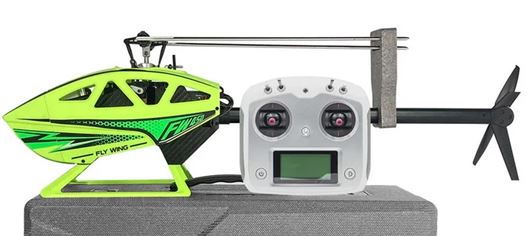
That depends on you...
Let's first get the GPS topic out of the way. If you want to learn how to properly and safely fly a collective pitch RC helicopter, then don't get a GPS auto-pilot equipped RC helicopter. It would be a waste of your time and money - full stop!
I cover this polarizing topic on my Auto Level Page, but the primary reason is simple, GPS auto-pilot won't allow you to build the required foundation of the many fine RC helicopter control piloting skills required to perform a basic hover, never mind progressing to more advanced flying. A small toy or fixed pitch RC helicopter will actually build way more transferable and helpful flying skills than any GPS RC helicopter ever will.
GPS RC helicopters are for people who want a quick, easy, and artificial drone-like flying experience; while having no interest in piloting an RC helicopter and don't mind spending at least double to get that electronic crutch to get a disposable product. So, if that's you, then GPS will be your best RC helicopter choice; but if you actually want to learn how to pilot a collective pitch RC helicopter while saving money, then stay away from GPS auto-pilot equipped birds.
I also don't prescribe to the common beginner belief that you must learn on a small easier to fly micro fixed pitch heli first before getting into collective pitch; granted, that's a way better learning option than starting on a GPS autopilot heli.
As a MAAC (Model Aeronautics Association of Canada) RC Helicopter instructor, almost everyone I've taught has started on larger (400 size and bigger) collective pitch machines out of the gate and did so (and continue to do so) with great success because they did their homework.
They knew exactly what to expect and got the priceless one on one help that only an experienced RC helicopter instructor can provide.
This is where I hopefully can help to give you some of that decades long field experience and knowledge if you can't get it locally from a good instructor or experienced RC heli pilot.
Let's first determine what exactly separates a good first collective pitch heli from a bad one.
You won't outgrow a quality collective pitch heli in a few weeks or months or have to spend a small fortune on upgrades to convert it into a decent machine. This of course means you will save both time and money.
That is one of the nicest benefits with collective pitch RC helicopters.
With most other RC vehicles, you generally start with slow and simple, then move up to fast and furious. Good collective pitch / 3D RC helicopters are VERY different.
You can get a high performance 3D RC helicopter and set it up for learning on turning it into a perfect & docile trainer, perfectly suited to your own skill set. Once you have mastered basic flight, you can make changes to your initial set-up to ring out as much 3D performance as possible or keep things relatively tamed down for general or scale type flying - that's all up to you.
The real benefit?
You'll have much more enjoyment and fun with a good quality collective pitch heli and equipment because you can tailor the way it flies and responds exactly to your ability and how you like to fly. As you improve, your helicopter has equal potential. You won't quickly "outgrow" it in other words.
WATCH OUT FOR THE MONEY PIT!
This hobby is expensive enough. We already covered tossing your money away on an overpriced GPS heli, but throwing your money down the drain on poor quality or flashy eye candy that doesn't fly, has no practical value, or is next to impossible to control is even more wasteful. So many have given up by going for lowest price or lured into a purchase by the bling alone.
Remember looks don't equal good flight performance, good quality, or even what's practical or efficient.
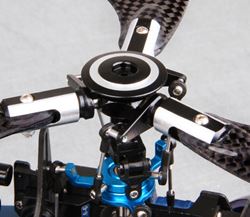
One such example of this we are seeing are multi-bladed rotor heads (more than two rotor blades) on entry level/low cost CP machines - pure marketing wank & hype.
For the scale crowd and for some specific areas of aerobatics, and after you know exactly what you are doing and are experienced, do GOOD QUALITY multi bladed heads have some merit, but that's it. Why?
- They are mechanically more complex
- Parts count is up
- Weight is up
- They are not as efficient *(increased drag & the tail rotor has to work harder because there is more reactive torque generated)
- They are harder to balance correctly
- Setting the blade tracking is harder
- Some require setting the phase angle of the rotor head in relation to the swashplate - complicated if you don't understand this process
- They cost more (initially & for repairs)
- Some are harder to transport
* Assuming same blade size/profiles.
In short, many of the advantages flybarless technology gives us, are lost with multi bladed heads. This is truly where bad RC helicopter marketing BS is trying to sucker in the uniformed.
Collective pitch RC helicopters are complicated enough as it is, and I STRONGLY recommend beginners keep things as practical and as mechanically simple as possible when starting out.
There's an old adage in engineering:
"Complexity Compromises Reliability"
This holds so true in our hobby.
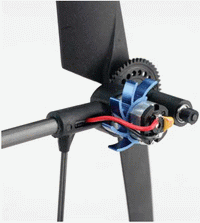 Beware. If you see a motor and gear like this on a tailrotor - WALK AWAY!
Another IMPORTANT thing to stay away from is larger collective pitch RC helicopters with fixed pitch, brushed electric motor tail rotors (especially ones with gear reduction).
They are rotten to fly & learn on!
Why? The tail rotors simply don't react fast enough (both in acceleration & deceleration rates) to correct for the ever-changing, at times violent reactive torque loads from the the main rotor.
In short they have very poor tail hold (how well the tail rotor holds the heli perfectly still along the yaw axis).
They also have poor tail authority (how well & equal the tail rotor produces thrust to yaw/turn the helicopter in both directions). These tail hold & tail authority factors are even more critical when first learning to hover and fly an RC helicopter.
If you don't have a solid tail hold, tail rotor control is vague at best causing constant tail blow out, quickly leading to disorientation and a crash. On top of that, brushed tail motors like these are
under enormous strain and usually burn out quickly.
Thankfully, these rotten things have almost completely disappeared from the market but there are still a few being sold and that's why I'm leaving this information on this page for a while longer.
They have mostly been replaced by much better performing small sized collective pitch helicopters (100-250 size) that have small direct drive coreless or better yet, brushless tail motors such as the Blade InFusion 180, XK K110, OMPHobby M2 & M1, GooSky S2 & S1 & T-Rex T15 to name a few of the better ones.
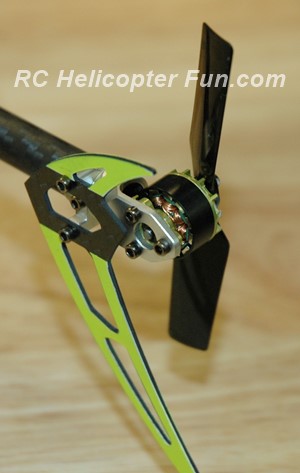 Direct driven, brushless fixed pitch tail rotor is an excellent choice on smaller RC helicopters.
Micro and small RC helicopters like these are small and light enough that the fast accelerating and decelerating direct drive coreless & brushless tail motors can keep up to the everchanging rotor torque.
They produce good tail hold & authority, don't burn out on a monthly basis and with a low parts count, are not maintenance intensive.
I demo how good the "direct drive brushless tail hold" is in the video below on the OMP Hobby M2 EXP review I did.
Tail hold is as good as a variable pitch tail rotor that we find on larger RC helicopters. Tail authority is almost as good.
As you can see, brushless tail motors really are the superior/best option if you are looking at any smaller RC helicopter. They work well up to 250's or so. Anything much bigger than a 250-300 size machine however, I highly recommend using a proper variable pitch tail rotor.
Fixed pitch vs. variable pitch tail rotor type likely doesn't make much sense to you right now, but it will after you are into this hobby for a while. If you want to understand tail rotors more, the fundamental differences & pros/cons of these two types of tail rotor design, please see my torque & yaw page.
The RC Controller (Radio / Transmitter) is Just as Important as the Helicopter
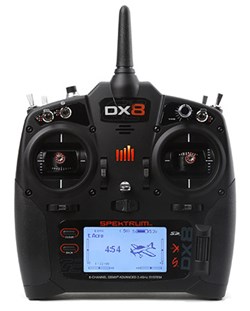
Don't forget about the radio (transmitter) either.
Once up to the level of single
rotor collective pitch, especially in this day and age with electronic
swash mixing, electric powered helicopters, flybarless systems
with remote gains, flight & stabilization mode selections and rescue features, the radio is just as
important as the helicopter; more so as far as I'm concerned. This applies to micro size CP's right up to the big beasts.
My page on RC Radios goes into why computerized radios are so important as well as some suggestions of what to get/look for.
Too many people don't follow this simple advice and are lured into a collective pitch RC heli purchase by low pricing, marketing hype, slick packaging, and eye candy (flashy colored anodized parts or multi-bladed rotor heads).
On top of all the glitz you are then stuck with a toy like radio (transmitter) that will not allow you to set the helicopter up correctly and EVERYTHING about collective pitch success is in the setup.
Welcome to the money pit.
Parts start failing and/or are completely inadequate and you find yourself spending way more on up-grades in parts and a computerized radio over getting what a decent quality collective pitch heli and computerized radio would have cost in the first place - please don't make that same mistake.
Newest Technology Doesn't Translate To The Best RC Helicopter or Make You A Better RC Helicopter Pilot.
Just because manufacturers are cramming all their latest technology down our throats while trying to convince us we all need their latest and often proprietary equipment to become better pilots and have more fun doesn't make it so. In fact, it's total nonsense; don't fall for marketing BS.
The fact is, the more flying engagement and solid understanding of the basics with less outside distractions in this hobby, the more most people enjoy it. We are losing this engagement, knowledge and flying fun to all these added distractions and technology; all while it quickly pulls money out of our pockets with little to no benefit.
Despite what others may say, with a few notable exceptions such as flybarless electronic stabilization & electric power; substantial and beneficial improvements in our hobby are incremental. My first RC helicopter from 1989 for example has the exact same fundamental components of my most recent RC heli including the frame, a tail boom, a rotor head, two rotor blades, a main shaft, a swashplate, a tail rotor assembly and landing skids. The basics simply don't change other than materials and layout.
When you're first starting out, you don't need the newest model off the assembly line. As you become a seasoned RC helicopter pilot and enthusiast, then you can consider investing in the newest & best, but the opposite will often happen.
You'll have the experience, flying skills, knowledge and wisdom to appreciate that the one or two year old model that is on a great sale or one that is lightly used, but still has good parts support, can often be the best RC helicopter choice if best bang for the buck is more important to you than ego driven flexing is.
What size is the best RC helicopter to self learn on? Don't ask me :)
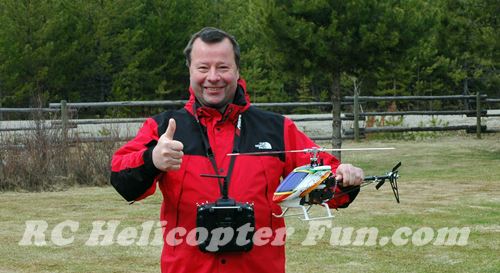 400 Size Collective Pitch RC Helicopter - I'm hopelessly biased.
Yes - I'm hopelessly biased towards 400 size class helicopters (using apx. 320 to 380 mm long rotor blades). This is due mainly to cost (both up front, for parts, & batteries) and the fact that the good ones work very well for beginner fliers right up to pros. I also enjoy instructing with this size more than most others.
By the way, if you don't know much about how RC helicopters are sized, I cover it in detail on this page.
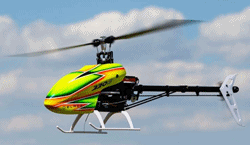
The Blade 330S and Align Trex 450LP ARTF are two very good ready to fly choices in my opinion.
Align is the better quality heli and value, plus it comes with a decent computerized radio, but those already flying RC planes with a Spektrum radio, then the BNF 330S makes more sense.
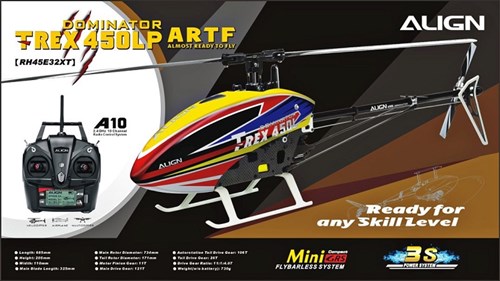
Regardless which of these two entry level 400 size machines you decide on, they both offer great value, easy to find parts and an affordable 3S battery power system.
400's like this are big enough to see in the sky at a distance, but small enough not to be overly intimidating/dangerous to learn/start on. They can handle moderate wind once you learn the basics and crashes won't bankrupt you either.
400's for the most part give you the most rotor size per dollar ratio of all collective pitch RC helicopter sizes ranging from micro up to monster. 400's also give fairly long flight times per battery pack/charge.
These to me are all very important benefits and why I still consider 400 size machines a good starting size to learn on. That of course doesn't mean you will as well.
Most Newbies Consider Micro (100-150 Size) Collective Pitch The Best RC Helicopters To Self Learn On.
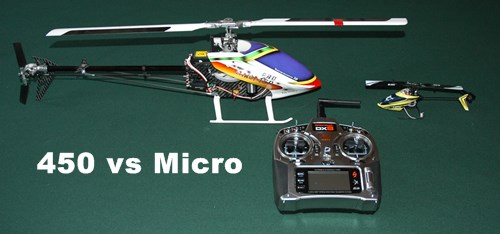 400 vs 100 Size Micro Collective Pitch - Which Is The Best RC Helicopter To Self Learn On?
100-150 size collective pitch RC helicopters are more stable than ever thanks to improvements in electronic stabilization. Helicopters like the aforementioned:
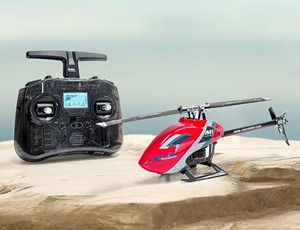
Micro's like these are low cost and rather "crash proof" because of their low weight and low energy release when they hit something; especially if you fly them over a soft thick lawn.
When you do manage to break something, repair costs are very inexpensive (usually under $20 bucks)!
Many more newbies are self learning collective pitch flying skills these days on these good quality 100-150 size micros and doing so very successfully!
There's no question, if you can fly and see a somewhat reactive 100 size collective pitch heli, you'll be able to fly any size collective pitch RC helicopter. So I certainly do recognize them as excellent options, and full well know 400's are not for everyone.
It's hard after all to justify a $600+ purchase when you don't even know if you'll like the hobby yet. Spending $150 to $250 or so on a micro is not nearly as risky (both financially and in the danger department).
On the flip side (pun intended), I also know people who even found 400's too small and only started having collective pitch fun & success when they went to a larger 500 to 600 size machine; tossing in the self learning towel and getting an instructor's help; I would certainly not recommend a 500-600 size machine to self-learn on!
In short, there is no "best size heli" for everyone to learn on.
If you're intimidated by the size and cost of a 400, or you have limited space, or been "grounded" by many RC fly restrictions; micro 100-150 size CP's are a fun & affordable way to be introduced into collective pitch provided you are not expecting too much out of them in terms of flight times, wind handling & ease of visibility at distance (bright colored canopies really help).
The benefits are obvious!
- They are very convenient for flying & practicing in your own yard safely.
- Repairs are cheap.
- They are under 250 grams which is the weight limit of many current RC flight restrictions.
- They are not at all intimidating as shown in the video below.
Don't Overlook The Very Capable Middle Child. The 200's!
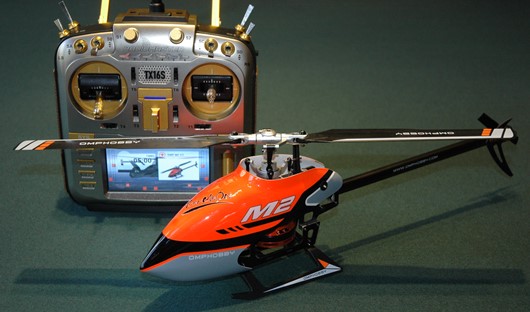
The OMP Hobby M2 series are a great option to consider for learning collective pitch flying skills on without breaking the bank. They are all wonderful flying little helicopters that "fly bigger" than they are; meaning they react and behave more like a 400 size helicopter. OMP Hobby makes some of the best quality & value RC helicopters around with great parts support!
The OMP M2's are spinning 175mm rotor blades and is about 400mm long (16 inches). Making them about 2/3rds the size of a 400 size heli, but double the size of a micro 100. They're tough, have all the latest electronic stabilization help aids such as auto level, an outstanding brushless tail motor for best in class tail hold and authority. They can even handle a fair amount of wind.
Over and above all that, the OMP Hobby M2's use brushless direct drive main motors. There is no gearing to worry about or strip out. Just a wonderful amount of smooth & efficient power providing impressive flight times upwards of 8 minutes when setup & flown tamely. They also won't break the bank (up front & for parts & extra LiPo batteries).
If you feel 400 size is too big/expensive, yet don't want a micro; the OMP M2 EVO and the GooSky S2 (a close cousin of the M2 EVO) are in my opinion the best options to consider. So many people have successfully learned flying collective pitch on the these quality 200 size machines over the past few years now and are having so much fun doing so.
Parts Availability - The Best RC Helicopter Deal Breaker!
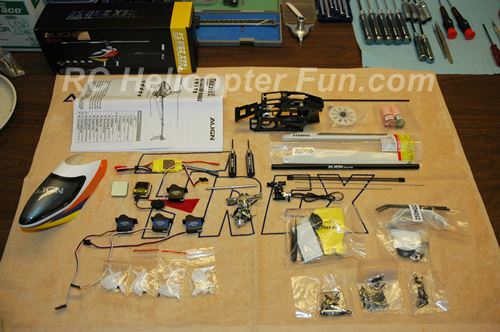 Collective pitch RC Helicopters, even small ones, have lots of parts!
No matter how careful or good you are, you'll need parts for your RC helicopter; either for repairs or maintenance.
This is something that many people don't consider when making their first RC helicopter purchase, but you soon find out how important it is.
If you can’t get parts or it takes many weeks or months to get parts, your helicopter is nothing more than a costly paper weight - very frustrating!
This again (as I have touched on numerous times already), is where getting into popular name brands pays big dividends. The more hobby shops or online shops that carry your specific brand, the easier it will be getting parts from any source.
More aftermarket parts are available as well with the big name birds such as batteries, canopies, gears, blades and other common "bits", which can be very advantageous for customizing or finding a part that the dealer doesn't carry anymore or has been discontinued.
Speaking of things being discontinued, this again is where the big name brands usually have longer model production runs and don't become obsolete as fast.
This longevity results in better resale value & desirability on most name brand heli gear so that is also something to take into consideration.
I always recommend if you have a decent brick & mortar local hobby shop (LHS) that is heli knowledgeable, pay them a visit first and find out what brand/s they carry. Being able to run down to the LHS when you need a part or two will save you a time and money over having parts shipped to you.
If your area has an RC heli flying club, go there as well and see what brands they are flying. Generally local clubs will also be flying what is available locally.
Naturally if you don't have a heli knowledgeable LHS or RC heli flying club, those above points are moot and you're going down the self learning / ordering online path.
Best RC Helicopter Teaching Aids
Once you decide on and get the best collective pitch RC Helicopter for your particular needs, now begins the steep & fun learning curve.
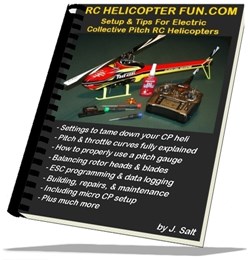
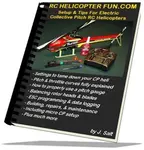
If you're self learning collective pitch, my Collective Pitch Setup & Tips eBook really dives head first into what you'll need to know when starting out and learning to fly a CP helicopter.
It covers all heli sizes from micro to monster and if you are not really certain what's involved with collective pitch yet, it's an inexpensive way to learn about it before spending a bunch of money on a heli. You will also be much better versed in the "terminology" and be in a much better position to make an informed heli purchase decision afterward.
I also enjoy helping my eBook customers. So if you've purchased this or any other eBook of mine and have narrowed your list down to a few helicopters, but still not sure which might be the best choice, please feel free to contact me and I'll give you my friendly 2 cents worth ;-)
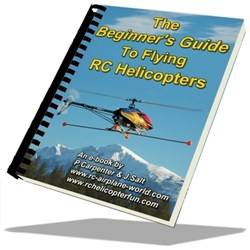
The Beginner's Guide To Flying RC Helicopters is another helpful eBook I offer, but is more focused toward true beginners. It covers all the various types of RC helicopters and is more of a general introduction to the hobby, whereas the Setup & Tips eBook is very topic specific on collective pitch.
I have a very popular "Heli School" section on my website that will teach you how to fly your collective pitch heli from the ground up to build a solid skill foundation using the same proven lessons I use when instructing one on one.
And no "best RC Helicopter" article would be complete without the mention of a good RC helicopter simulator which is a must have learning aid these days in my opinion. One could even go as far as saying the best RC helicopter is an RC helicopter simulator when first starting out (provided you are using it correctly to learn the fundamentals).
Additional Best RC Helicopter Information
- Fixed Pitch & Collective Pitch - What's the difference
- Helicopter Size
- Kit or Ready To Fly (RTF)
- New or Used
- Should Auto Level Be Used When Learning
- Pod & Boom vs. Scale
- Power Options…Electric, Nitro, Gas, Turbine
Wow! Lots of things to consider.
Just remember, take your time as you learn all this! Hobbies are suppose to be relaxing too. Taking your time right now with this "Best RC Helicopter" decision process will pay big dividends later on and you will get more enjoyment from the hobby and get more out of it.
Lastly, collective pitch / 3D RC helicopters are not for everyone.
They take a serious time commitment and "Stick To It" mind set to learn all about the systems within them (both electrical and mechanical), basic helicopter flight theory & principles, and naturally lots of time and practice learning how to fly them. This is a complicated hobby after all and RC helicopters are complicated machines.
Successfully getting into the hobby and learning to fly a collective pitch RC helicopter is about as far removed from instant gratification as it gets. It can takes years for some people to understand and fly them well; 6 months to a year is the average for most however.
I've been an RC helicopter enthusiast for over 35 years now, and still learn something new almost daily! Likely forgotten more than I remember but that's why I'm helplessly hooked; I love that never ending learning curve aspect of the hobby.
If you don't have much free time and want near instant success or gratification; please stick with the ready to fly variety of toy, micro fixed pitch, and GPS types of helis - these will be the best RC helicopters for you.
For those of you looking for a hobby you can grow with, has
endless options for different and varied flying styles, offers up the
same control as full size helicopters, and provides a lifetime of
rewards and challenges; collective pitch / 3D provides all
that and will be your best RC helicopter choice.
Addiction is a word I
often get from many of the people who contact me with RC helicopter
stories and yes, this hobby can be very addictive, but that makes
learning about it and sticking with it for years all that more fun.
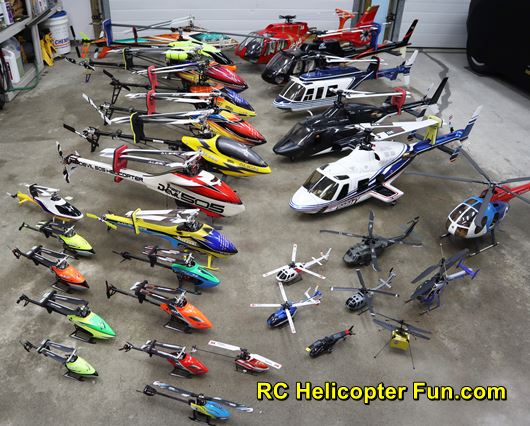 My Current RC Heli Fleet. You'll Know You're Hopelessly Addicted To RC Helicopters When Something Similar Happens.

Need Heli Help?
- Getting into the hobby but have no one to help you?
- Are you feeling overwhelmed & confused?
- Are you tired of wasting time seeking partial and conflicting information?
- Don't understand the maze of RC heli setup fundamentals?
- Is that sickening feeling after crashing turning you off the hobby?
- Are you simply ready to give up?
My RC Helicopter eBooks will help you with those exact problems. Grab your copies today.
Click Here For More Information
Click Here For More Information
Click Here For More Information
Recent Articles


-
RC Helicopter e Books To Help You Succeed In The Hobby
Dec 18, 25 08:05 PM
 New to the hobby? Self learning & need help? Frustrated? These RC helicopter e Books will help, while cutting your learning time down substantially.
 -
Toy Helicopters - Which offer the best value & fun in 2026?
Nov 25, 25 06:23 PM
 With so many toy helicopters on the market in 2026, which are worth your time and money? Here are my top recommendations.
 -
RC Helicopter For Kids & Beginners - Making An Informed Purchase
Nov 25, 25 06:19 PM
 How To Choose The Best RC Helicopter For Kids & Beginners in 2026