RC Field Box Essentials
by John Salt - Last Updated September 2023
So what is the RC field box (also called the RC flight box), and why do you need one?
The field box is essentially a tool box that you take to the flying field with you.
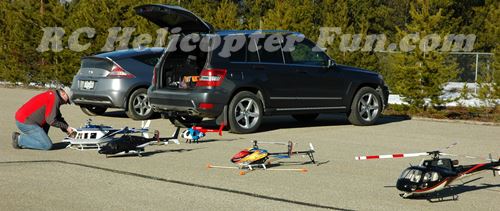
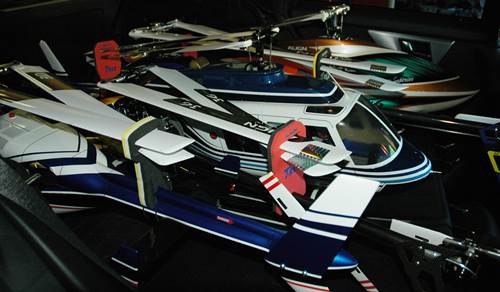 No room left in the back of the vehicle for the RC field box. Looks like it gets to ride shotgun - again!
This "tool box" usually holds your radio, some tools, LiPo batteries & maybe charging equipment for electric helis.
For fuel powered RC helicopters & planes, it will also contain starting equipment and fuel. Stocking your flight box with a number of small, yet common wear & tear parts for quick "field repairs" is also a good idea.
Basically you are bringing a little bit of your workshop out to the flying field if you need to make adjustments, small repairs, and have a convenient way to carry and get all that stuff out there in some resemblance of an organized fashion.
I need all the help I can get in that department when the back of the vehicle is jammed full of flying egg-beaters.
Nitro vs Electric RC Field Box
Below I'm showing two examples using my personal RC Field Boxes. The first one is specifically for nitro helicopters, the second one for electric helicopters. I'll explain why they differ and how they are stocked differently.
Nitro RC Field Box
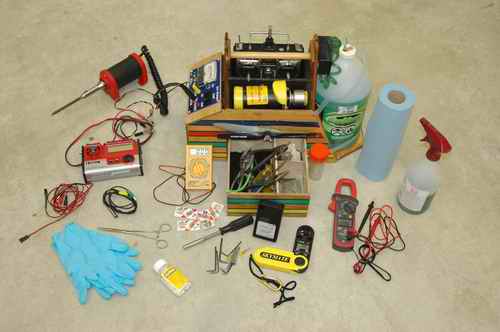 Typical Nitro RC Field Box
The above picture shows an example of a basic well equipped nitro RC flight box with tools, spare parts, fuel, and starting equipment. You can make your own RC flight box, purchase a kit, or purchase a ready built box – it is up to you and your budget.
I have all the various tools and items that are in this and the electric field box listed further down the page under the "Stocking Your RC Field Box" section, but I just wanted to point out the main differences between the two before getting into all the "junk" that you end up putting in them ;-)
A field box specifically for nitro differs from electric in two main areas; but you can certainly use the same field box for both. I just find it easier having two separate ones.
The two main differences is the nitro box usually has an extension on one end to hold a one gallon jug of nitro fuel along with an electric fuel pump. The other end has a compartment for a 12VDC gel lead acid battery & power/glow panel which is needed to power the starter, glow plug socket or driver/charger, fuel pump, and maybe a small computerized battery charger if you take one out to the flying field.
Here's a close up photo of a typical power panel.
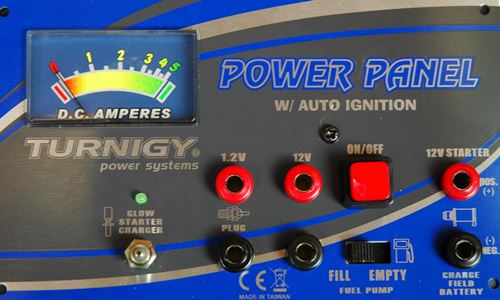 Nitro Power Panel
Electric RC Field Box
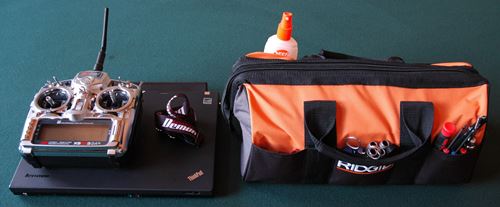 Electric Power RC Field Box
Okay, it's not a box, it's a bag, a nylon tool bag to be exact. I have found this small sized tool bag perfect for my electric RC needs.
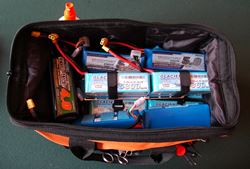
It has lots of nice little compartments inside and out for tool and accessory storage, it's light, inexpensive, and perfect for holding/carrying a bunch of heavy LiPo's and removable battery trays.
You could certainly use one of these tool bags for nitro as well if you have on-board glow drivers in all your aircraft, electric starter with built in battery, and don't mind them getting oily from the nitro fuel. This flight bag I've been using for the past few years was just a freebee that came with a cordless drill set.
There are certainly nicer nylon tool bags/totes out there with even more and better storage compartments for things like your radio etc. If you don't already have one of these little tool bags or totes kicking around your shop or garage; next time you visit your local hardware or tool store, take a stroll down the tool box/bag isle to see what jumps out (and better yet is on sale)...
As you see, I'm also showing my old trusty ThinkPad laptop which is perfect for rough RC field use.
Bringing a laptop out to the field is something I don't always or even like to do; but with all the flybarless systems and ESC's that are programmable or have data logging features; I find more times than not, I'm reaching for the laptop at least once or twice during a day of flying (especially on newer builds that I'm still adjusting/tweaking or collecting post flight data on).
I also use the laptop for FPV flight recording/playback when I want to record a FPV flight; so like it or not, the laptop has become an extension of the field box in this day and age.
That said, more and more FBL systems and other electronic goodies also offer Bluetooth connectivity with your smartphone; so the laptop at the field may soon be a redundant fixture only - can't wait!
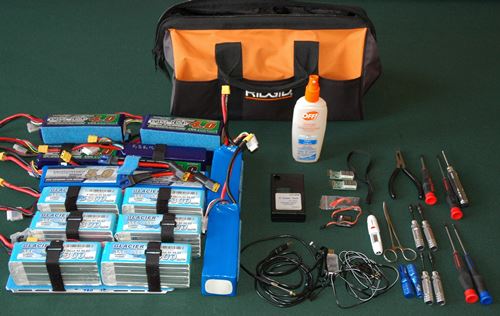 Typical electric RC field box / bag, contents.
Shown above is what I normally have crammed into my my electric RC field bag. It can hold a good afternoon's worth of LiPo packs, basic tools, electrical test equipment, USB cables/dongles to plug into the various components on-board the aircraft, and of course bug spray or sun screen. I suppose that is a good lead into what items you generally take out to field.
Stocking Your RC Field Box
Below I have a fairly complete list of everything I usually take with me out to the flying field in my flight box/bag along with some other items that are usually thrown into the back of the vehicle.
I have basically divided it into two categories: should take & maybe take.
The should takes are the items I personally could not leave behind when I go flying, the maybe's are things I sometimes take, but don't consider them must haves.
I've also noted any items that are specific to fuel/nitro or electric.
This is by no means an exhaustive & perfect list for everybody and you'll find out soon enough after getting into the hobby what stuff you left at home that you should have brought or stuff that you bring and never end up using.
Hopefully however this list will give you a good starting point.
I did try to include links when I could from one popular online source so you can have a peek at the individual items in more detail if you wish to learn more about them or need to order anything.
RC Field Box Should Takes:
- RC Field Box or tool/tote field bag (obviously) :-)
- Power Panel (for nitro birds)
- 12VDC Power Panel Lead Acid Gel Battery (for nitro birds)
- Glow Plug Cord or Glow Driver (for nitro birds)
- Starter (for nitro/gas birds)
- Heli Starting Shaft of the appropriate size (most nitro helis use 6mm hex hubs) to use with the electric starter (for nitro birds)
- Electric or Hand Crank Fuel Pump (for nitro/gas birds)
- Nitro Fuel (for nitro birds)
- Premix Gas/Petrol (for gas powered birds)
- LiPo Batteries (for electric powered birds)
- Premix Jet A (for turbine powered birds)
- Starting Gas (for non kerostart turbine birds)
- CO2 fire extinguisher (for turbine powered birds)
- Glow Plug Wrench (for nitro birds)
- Spark Plug Wrench of the appropriate size (for gassers)
- Extra Glow or Spark Plugs (for nitro/gasser birds)
- Basic Metric Hex Driver Set (common sizes 1.5mm, 2.0mm, 2.5mm & 3.0mm)
- Metric Alan Keys (if you don't want to bring/purchase a hex driver set)
- Basic Metric RC Socket Driver Set (common sizes 4.0B, 5.5B, 7.0B & 8.0B)
- Precision Screw Driver Set
- Ball Link Pliers
- Basic Plier Set
- Basic Multi Tool
- Multi Cell Battery Monitor (for LiPo/LiFe electric birds)
- Binding Plug/Harness in case you need to rebind your receiver (we all have lots of these kicking around usually)
- A few spare ball links, screws, setscrews, nuts, etc. (you'll know as you gain experience in the hobby what small hardware or even spare parts to bring out to the field)
- Electrical Tape & Zip Ties
- Paper Shop Towels (a must for fuel powered birds / but comes in handy for electric as well)
- Bug Repellent, Sun Screen, Ball Cap, Sun Glasses, Extra Jacket, Radio Neck Strap
- Drinking Water - I like to fill a water bottle half up with ice cubes and top it full with water. It stays nice and cold as the ice melts for several hours even on a hot summers day.
- If you fly in the winter, a Transmitter Glove
- Aspirin/Tylenol - no explanation needed ;-)
- Change of Underwear - only if you fly 3D ;-)
RC Field Box Maybe Takes:
- Computerized Battery Charger (for field charging) I generally take my iCharger 306B with me when I do take a charger, but I honesty don't bring the charger often. This really depends on how many LiPo packs you have if you can bring enough fully charged ones from home to get you through or need to charge a few here an there.
- Charge harness/s or Para-Board/s for your particular LiPo, RX, or TX packs if you plan on field charging
- Laptop & Required USB Cables/Dongles for your particular flybarless system/s, ESC/s, data loggers, FPV flight recorders, etc.
- DVM (digital volt meter)
- Transmitter Case
- Ball End Driver Set
- Wire Cutters/Strippers
- Small Tube of Thread Lock (blue/medium strength is good for most applications)
- Small tube of A/B Epoxy or CA Glue
- Pitch Gauge
- Tweezers
- After Run Oil (for nitro birds)
- Extra Fuel Filter/s (for nitro birds)
- Extra Silicone Fuel Line (for nitro birds)
- Optical Heli Tachometer
- Wind Meter
- Windsock (if your flying field doesn't have one and you are not good at jugging wind direction - for helicopters, not really needed I find)
- Foldable Lawn Chair
- Battery Powered soldering Iron & solder for electrical wiring/connector repairs out at the field. The TS-100 Digital Iron that can be powered from any 12 to 24VDC power source is by far the most popular for RC field use these days.
- Some spare male & female RC connectors for your LiPo battery preferred plug type (EC3/5, Deans, XT60/90, Traxxas, etc.)
- Surgical Gloves if you want to keep your hands clean (nitro birds mostly so the oil goo on your paws doesn't get all over your radio)
- Phone/Camera
- Infrared Laser Thermometer
- Wife/Husband, Girlfriend/Boyfriend (remember, this is the maybe list as in maybe not) ;-)
Well, that just about wraps up what you should, and maybe should, be taking out to the flying field in your RC field box. This is a fairly RC helicopter specific list but much of the same stuff I used with planes as well so if you have a plane, this list should also give you some good ideas and much of what I have listed here you already have and take out to the flying field in your RC field box.
See ya out at the field :-)
As an Amazon Associate I earn from qualifying purchases.
Need Heli Help?
- Are you getting into the hobby and have no one to help you out?
- Are you feeling overwhelmed & confused?
- Are you tired of wasting time seeking partial and conflicting information?
- Is crashing due to not fully understanding helicopter setup turning you off the hobby?
- Are you simply ready to give up?
My RC Helicopter eBooks are here to help you with those exact problems.
Click Here For More Information

Click Here For More Information
Click Here For More Information
 Interested In RC Airplanes Too? Save Money With The Beginner's Combo Package
Recent Articles


-
OMPHobby RC Helicopters Let You Master The Skies
Apr 18, 24 07:21 PM
 Don't settle for anything less! OMPHobby RC Helicopters are built to last while taking your flying passion to a whole new level.
 -
Best Flybarless System In 2024 - Is There Such a Thing?
Apr 02, 24 09:08 PM
 Looking for the best flybarless system? Let's look at what's out there, pros & cons, features and pricing, to help you narrow your list.
 -
Learn How To Fly 3D Helicopter Aerobatics
Mar 15, 24 03:30 PM
 Want to learn how to fly 3D helicopter aerobatic maneuvers? Follow this skill building lesson plan to succeed.