Scale RC Helicopters: What You'll Need To Know Before Considering Scale.
How Does Scale Differ From Pod & Boom? What Types Are Available? Are They Harder To Build & Fly? How To Choose The Best For Your Experience Level.
by John Salt - Last Updated March 2026
Flying scale RC helicopters might be your long term RC helicopter goal. It certainly was mine when I was first getting into the hobby & still is to this day.
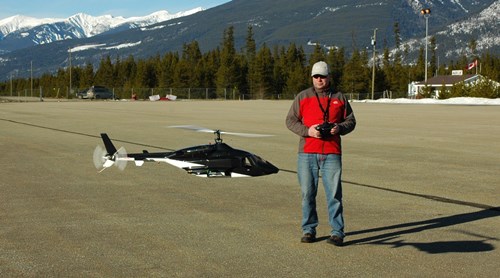 I Love Flying Scale RC Helicopters
To be perfectly honest, if I wasn't trying to cover and understand most aspects of rotary RC aircraft on this website; I would put every cent, every available minute, and every resource into scale.
Scale RC helis are my true passion & love in this hobby. If I was forced to give up every type heli I own/fly right now except one, the big scale birds would stay and the rest would go.
Video below shows one of my scale heli builds.
If you even have the slightest feeling scale might be something to strive towards as I did, that is a great goal and I encourage you 100% to follow that ambition. Scale after all is underrated and somewhat unappreciated. This stems from two opposing & completely opposite fronts...
First we have the 3D world demanding higher and higher power, lightning fast reacting collective pitch RC helicopters which are not well suited for scale or scale fuselage fitment.
Next we have the "Drone Noise" that is taking much of the focus & skill away from true RC helicopters (scale, sport, F3C & 3D).
Combine the two, and scale seems to be some sort of unknown not to mention the many misconceptions about scale RC helicopters.
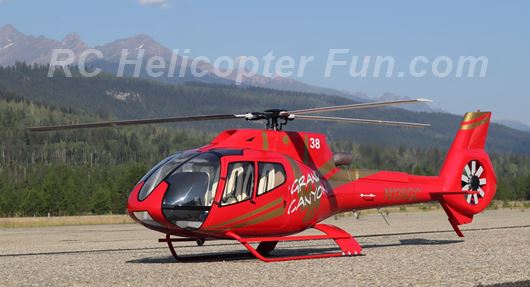 My First Fenestron Trail Rotor Scale RC Helicopter - Roban 800 EC-130
Short on time? Scale type flying doesn't care...
One of the best things about scale RC helicopter flying is you don't need to practice all the time to stay sharp like you do with aerobatics and 3D. Seems we are all short on time these days and not feeling pressured to get out and practice all the time (for me anyway), can be a big positive when my plate is overflowing.
That's not to say flying a scale RC helicopter is easy, it actually requires & builds a whole new set of flying skills to correctly "emulate" how full size helicopters behave. This requires a super smooth and fluid flying style with a knowledge of what aerodynamic principles affect full size helicopters.
If you can appreciate all this and are thinking that "scale RC helicopters are definitely for me" GREAT; but as an instructor, I strongly encourage you to learn & become a proficient RC heli pilot on a Pod & Boom helicopter first.
What’s the difference between Scale and Pod & Boom RC Helicopters?
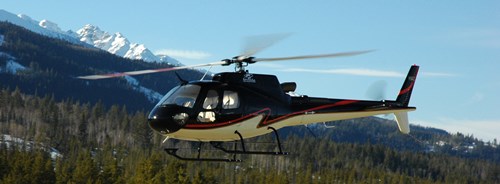
The majority of larger scale RC helis are fitted (covered or
skinned as I like to say) with a fuselage (body) to resemble many different
types of real life, full size helicopters.
Pod and boom helicopters on the other hand are exactly that – a “POD” up front that encapsulates most of the helicopter mechanical systems. Exiting the back end of the pod is a long aluminum or carbon fiber tube called the “BOOM”. The tail rotor is then attached at the end of the boom.
 Trex 800E Pod & Boom RC Helicopter
Pod & Boom RC helicopter design is by far the most common type and best RC helicopter choice when you are first starting out in the hobby. They are what you first learn on, and later on for many, what you use inside your first scale RC helicopter.
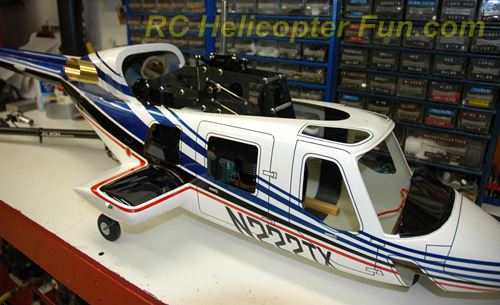 Mounting Pod & Boom Mechanics In Bell 222 Scale Fuselage
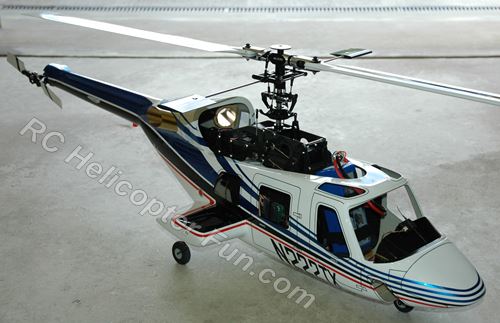 Scale Bell 222 Ready For First Test Flights. Not Completely Finished Just In Case Something Goes Horribly Wrong!
Why Start Out With Pod & Boom?
There are three main reasons most people start out and learn on a Pod & Boom RC helicopter:
1. Simplicity is key when you're starting out.
Fitting a scale fuselage over pod & boom mechanics is generally not easy and adds considerable complications and time to the build process. I'm always reminded of the old engineering adage complexity hampers both execution & reliability.
You will also be making adjustments (static and dynamic) to your helicopter at first after it's built and during the first few flights. These adjustments are much easier when you can see and get to everything on a Pod & Boom heli. A scale fuselage usually makes these adjustments more difficult.
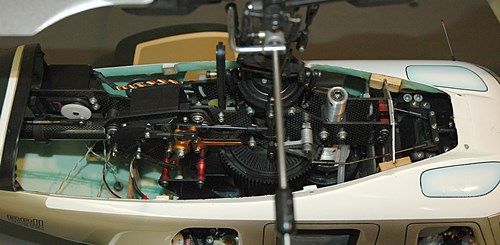 A Tight Fit!
As you can see from the above picture, stuffing your pod and boom mechanics into a fuselage limits the access to many components. Fitting the mechanics into the fuselage is generally not an easy task - there is lots of trial fitting, perhaps some trimming, usually some customization involved, and most definitely some cursing and head scratching.
I would never put brand new mechanics into a fuselage either. There are just too many unknowns with a fresh build from mechanical adjustments to FBL system programming. Only after several successful test flights of the mechanics in Pod & Boom configuration do I feel safe to fit them into a fuselage.
Here's a video I made showing a fairly typical scale RC helicopter mechanics install to give you a basic understanding of what's involved.
2. Fragile at Higher Costs & Weight.
Larger scale fuselages are not cheap. A good quality pre-finished fiberglass fuselage can cost as much or more than the pod and boom helicopter kit you are putting into it.
Whenever you introduce a scale fuselage (from micro to monster), you increase the cost, weight and complexity; but the most import aspect of scale to realize is scale detail is fragile!
The more detailed, the more fragile it gets. This also holds true for the less expensive RTF (ready to fly) micro and small scale RC helicopters on the market such as XK's K123 AS350 and small easy to fly GPS autopilot scale RC helicopters such as the various FlyWing 470 size scale helicopters.

No question, if you're desperate to fly a scale RC helicopter, but don't want to learn how to due to time or other reasons, the easy to fly FlyWing lineup of small, GPS equipped scale RC helicopters are hard to beat!
Just keep in mind that when you crash one, even lightly (and as a beginner you will, even with GPS help), substantial damage and a costly repair will follow. It's much more difficult and costly to repair a scale RC helicopter than a pod & boom RC helicopter.
It's worth pointing out these small GPS scale helicopters are not far of the cost of a much larger 550 or 600 size non GPS RC helicopter, so that electronic crutch comes at a price premium. Putting the time & effort into learning to fly a collective pitch RC helicopter will pay big dividends later in terms of both piloting skill and money saved. That is of course up to you :)
The much lower cost, yet harder to fly XK K123 in the video below is still fragile, but because it's a micro size heli, it has much less mass, inertia and energy release when the ground interferes with your flight. Micro size scale helis like this are certainly more robust than a 470 size scale GPS FlyWing heli, but not nearly as robust as a micro sized pod & boom RC helicopter.
What I'm trying to get across here is even with the small stuff, most folks I've helped over the years, soon come to realize the importance of first becoming a proficient RC helicopter flier on a pod & boom heli before getting into scale, even with the smaller and easy to fly GPS ones.
Just a slightly hard landing that a Pod & Boom would survive will damage most scale RC helicopters. Most body shells are not designed to take impact forces. The landing struts or in some cases retractable gear are generally not as strong as beefy and springy pod & boom landing struts. The horizontal & vertical tail fins are not as strong, and the overall weight is up releasing more impact energy when things do go wrong.
Crashing a scale RC helicopter while learning is very disheartening to say the least. A fuselage is pretty much a mangled pile of garbage even after a light crash.
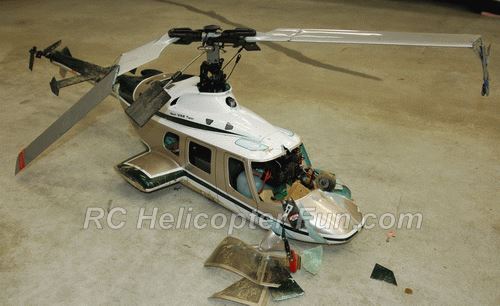 Light Crash - Major Damage!
3. You have to get a Pod & Boom heli regardless (for the larger sizes).
Remember, you generally get the fuselage separate and fit it over your pod & boom mechanics.
There are exceptions to this as we just saw with ready to fly micro & small scale helicopters. There are also a few larger RC helicopter manufacturers that have "Super Scale" kits. These special and more advanced scale RC helicopter kits come with special helicopter mechanics that are specifically sized and engineered to fit into their specific scale fuselages.
I discuss these higher end super scale models in more detail on the bottom 1/4 of this page and why they may not be the best choice for your first steps into scale helicopter flying.
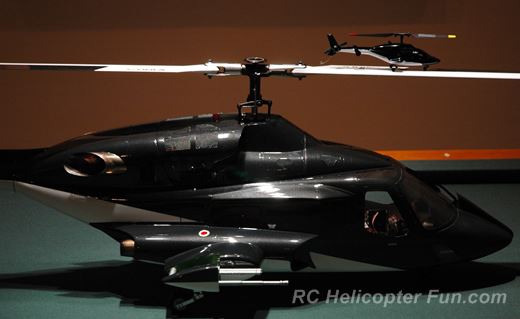
Best Scale RC Helicopter Fuselage Manufacturer (not super scale)
This is of course subjective, but in my opinion, one of the best pre-finished (meaning all painted) fuselages are manufactured by Fun Key Manufacturing (link takes you to my review on them).
Century Helicopter Products used to be the FunKey fuselage distributor in North America and many people thought Century Helicopter made these fuselages; but if you look at the name decal inside, they are in fact FunKey.
FunKey Manufacturing makes popular helicopter bodies to fit 550/30, 600/50, and 700/90 size RC helicopter mechanics. I'm always impressed every time I open the box of a new FunKey fuselage when I order one for myself or a custom build.
The fiberglass layup work is outstanding and the paint job is true automotive quality! Most of their bodies also have carbon fiber reinforcements in the high stress areas of the fuselage adding to the overall quality and strength.
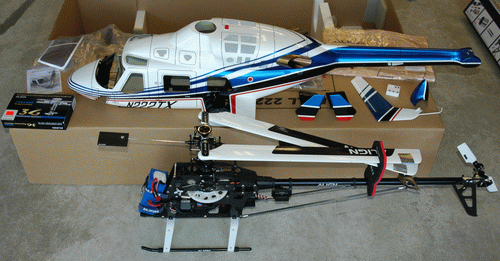
Pictured above, we have a typical scale FunKey fuselage right out of the box.
I am just doing a final sizing here to make 100% sure the pod & boom mechanics will fit and all the important measurements all line up. These Trex 600ESP mechanics have seen many test flights and I feel 100% confident that they will offer the bullet proof reliability I need for this scale RC helicopter project.
If
a scale RC helicopter is your goal and with that last point in mind
when deciding on your best RC helicopter kit; make sure the kit you get
will support the fuselage you want or vise-versa.
If you have a set of T-Rex mechanics for example and you like the Bell Jet Ranger, you can't just assume every Jet Ranger fuselage out there will fit it.
That is another thing I really like with FunKey's fuselages. They have very good measurement schematics on every model they make taking most of the guess work out of it so you know your pod and boom mechanics should fit in the specific fuse you are considering.
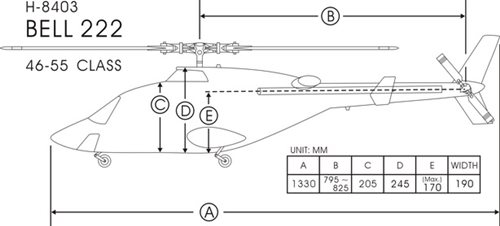
Above is a typical FunKey Sizing Schematic/Chart. With these few yet very critical dimensions listed, you can be 95% sure that your specific set of pod & boom mechanics will fit. The unknown 5% comes down to things like rotor-head components & linkages not having enough clearance in the dog-house requiring some fuselage grinding or customization. Same goes for the tail rotor linkages.
Scale RC Heli Fuselage Materials
One more item to consider is what the RC helicopter fuselage is made from; there are basically three in use today:
- Polystyrene (foam) is only used on small toy scale RC helicopters. It's inexpensive and light weight. Unlike the scale RC airplane world where "foamies" have taken over; it's doubtful we'll ever see "foamie fuselages" for our larger scale RC helicopters.
- Polycarbonate is light and inexpensive. It's used mostly on micro to small size scale RC helicopter bodies. Cold weather makes polycarbonate very brittle; something you should consider if you fly outside in winter.
- Fiberglass is heavier and more expensive but stronger than polycarbonate. It's the by far the most popular and best RC helicopter material for larger RC helicopter canopies and fuselages in terms of price to strength/weight/longevity ratio. Fiberglass handles the cold and vibrations better than polycarbonate. It also is fairly easy to make “good as new” repairs to fiberglass if it has suffered from light damage. Easy to source fiberglass auto-body repair materials work very well for this.
 Repairs To Crash Damaged Fiberglass F3C Fuselage Using Fiberglass Cloth, Resin, & Light Weight Auto Body Filler
I'm very happy with my fiberglass FunKey bodies considering they are all over a decade old now and holding up great!
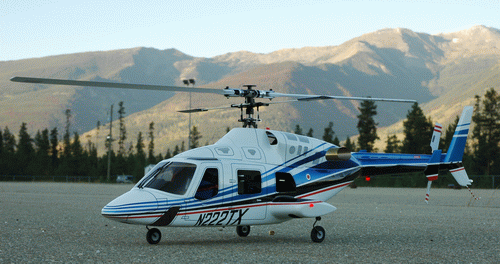 Funkey 600/50 Size Bell 222 Scale RC Helicopter
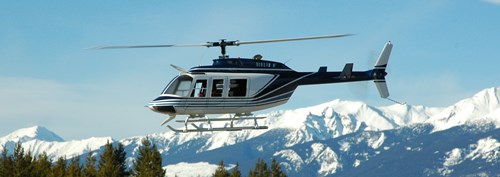 Funkey 600/50 Size Bell 206L (Long Ranger) Scale RC Helicopter
 FunKey 600/50 Size AirWolf Scale RC Helicopter
Semi Scale vs. Super Scale RC Helicopters
All those FunKey scale RC helicopters pictured above are classified as "Semi Scale". This simply means they don't have the same level of detail & full scale interiors that "Super Scale" helis have. Semi scale usually don't have working/opening doors which most super scale fuselages have and they are generally not bigger than a 700 size, because they are sized to use conventional pod & boom mechanics.
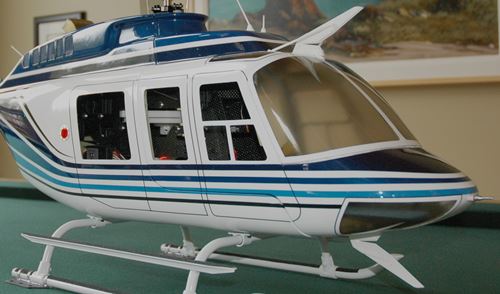 Semi Scale Bell 206L (600 size class)
The first thing you'll notice is you can see all the mechanics inside this semi scale heli.
This is the main distinction between semi scale & super scale.
There are other exterior details that super scale generally have that semi scale don't such as cable cutters, step plates & bars, bear's paws, antennas, pitot tubes, rivet detail, etc.
That however can all be added onto semi scale just as I have done on this Bell 206 Long Ranger.
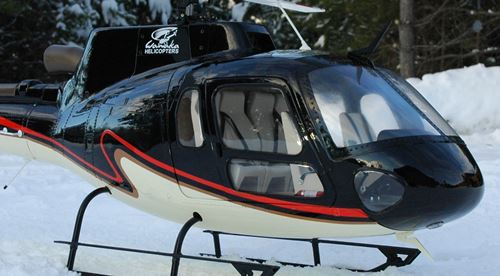 Super Scale Eurocopter AS350 (700 size class)
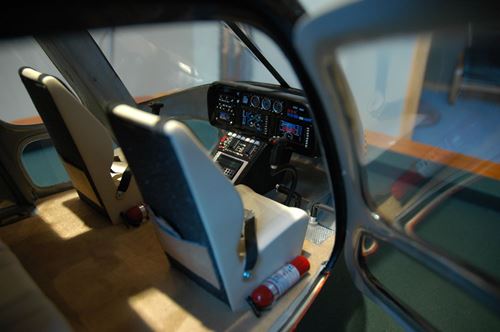
In comparison on this super scale RC heli, you'll notice it has a full scale interior and all the mechanics are hidden.
This is achieved by using customized mechanics that are purpose designed for the particular scale body they are being installed in.
In other words, they are not simple pod & boom mechanics that you just install a fuse over.
Why I Recommend Starting With Semi-Scale
Semi scale is by far the best way to introduce yourself to scale RC helicopters since it costs substantially less (both for the kit and taking into account you likely already have the pod & boom helicopter mechanics), takes less time to build, and is not nearly as finicky. Not to mention, not nearly as depressing if you happen to crash.
First flying a lower cost pod & boom heli fitted with a scale fuselage teaches you how to fly a "heavy" RC helicopter and what to expect.
There are fundamental differences in how a heavier scale RC helicopter behaves compared to what you are likely used to with your sport/3D pod & boom. Two ones we all learn early on when making the transition to larger heavy scale helicopters are vortex ring state & settling with power. They can bite fast and destroy a large heavy scale RC helicopter if you don't know how to recognize when they are about to occur and if they do, how to recover.
Other important things you will first learn and gain invaluable experience with on your lower cost scale converted pod & boom helicopter will include:
- Identifying & correcting component cooling concerns which can be an issue with enclosed scale fuselage.
- Scale specific maintenance/issues.
- Setup difference on both helicopter and flybarless/flight controller for scale.
- Fuselage vibration resonance and ground resonance identification & prevention.
- Thinking ahead while flying.
- Power & collective management differences.
- And of course what I personally enjoy best about flying scale; dialing in your own unique scale flying style, striving for full size behavior, fluidity and accuracy.
Once you have mastered semi-scale however, super scale is the next rewarding and fun step. As I mentioned below the video on the top of the page, making/fitting all the little scale details for inside the cockpit such as the fire extinguishers, seat belts, collective sticks, tail pedals, scale pilot and even dressing up what was included, added an entirely new dimension to the hobby. I know not everyone likes modelling little details, but if you do, you'll likely really enjoy that aspect of super scale.
Super Scale RC Helicopter Recommendations:
There are not many super scale RC helicopter manufacturers out there because we are now into a really niche segment of an already niche hobby. The two most common are Vario Helicopters & Roban Models.
Vario is the higher end of the two, but you pay big coin for that quality. Roban on the other hand is more affordable, but the quality is not as good; still, for the price, Roban is hard to beat in my opinion.
Here is an unboxing video of their 800 size EC130 to give you an idea of what their overall quality is like.
Other large high end super scale RC heli manufacturers include: Alterbaum Premium Helicopters & Helikopter-Baumann.
These large, higher end scale RC helicopters are generally all turbine powered or electric powered.
Gas and nitro have been phased out; eliminating both the oily mess and high vibrations these two powering methods produce, which over time, slowly destroy scale fuselages.
 Super Scale Flight Test Platform
What on earth is that ugly thing you ask?!
Remember me saying earlier on in the article that "only after several successful test flights of the mechanics in Pod & Boom configuration do I feel safe to fit them into a fuselage".
Well, this holds just as true for super scale. Since super scale mechanics are customized for particular fuselages and can only be flown once installed in the fuse, some folks will install them and hope for the best - NOT ME! I have been involved in this hobby way too long to take anything as complex as a fresh heli build for granted.
It took perhaps an extra hour at most to build that prehistoric looking test platform out of some 2x4 and 1x4 lumber along with an old set of landing skids/struts I had lying around, and then fit the super scale mechanics onto it. I then flight tested, flight tested, and you guessed it - flight tested some more.
Stuff like flybarless tuning, ESC programming, blade tracking, vibration analysis, post flight data analysis, etc.; I had it all sorted out before installing the mechanics into the fuselage. It was also much easier to access the mechanics for adjustments and I'm sure that alone saved well over an hour. For me, the little bit of extra effort to build this goofy looking test platform was well worth it and actually saved me time - maybe even a helicopter ;-)
The video below goes over this "testing" in more detail.
 Roban Super Scale AS350 Interior
How To Determine Scale RC Helicopter Ratio To Full Size?
I recently got this question and figured I should address it here.
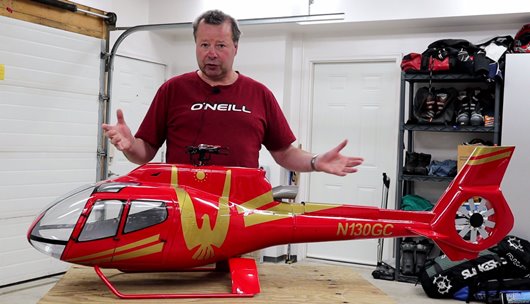
The person who contacted me was confused about RC helicopter sizing and how that relates to scale ratios of full size helicopters. He for example was looking for a 1:9 scale RC helicopter fuselage, but didn't know what size of RC helicopter to get for that overall scale ratio. The simple answer is there is no relation or correlation between RC helicopter sizing and scale ratios; let me explain...
You could have two different 600 size fuselages be totally different scale ratios to their full size counterparts. For example, a 600 size MD500 fuselage is going to be a larger scale than a 600 size Bell 222 fuselage because the full size MD500 is a smaller helicopter than the full size Bell 222. In fact, even though the two scale RC helicopters are roughly the same size using 600 mechanics, the scales of each can be substantially different.
For instance, a 600 size Bell 222 is about 1:9.6 scale, but the 600 size MD530 is about 1:6.2 scale.
To find the actual scale of any particular scale fuselage you are looking at, you simply get the overall dimensions of it, and then compare them to the overall dimensions of the full size machine to get the final scale.
For example, the FunKey 600 size Bell 222 fuselage is 1330mm long. The full size Bell 222 fuselage is about 42' long (12,802mm); so the 600 size FunKey fuselage works out to a scale of about 1:9.6 (12,802mm/1330mm).
On the other hand, the full size MD500 is about 24' long (7315mm), and the FunKey 600 size MD500 is 1180mm long so the scale works out to about 7315mm/1180mm = 1:6.2.
To find the dimensions of full size helicopters, use the interweb to search for "dimensions of whatever helicopter" you want to know. Look at few different search results since there might be an error but if several pages all state the same or roughly same dimensions, you know it's a safe bet that is the actual size. I find length (nose to tail) is generally the best dimension to use in the calculation as it's the longest and therefore will give the best overall scale resolution between full size and the model.
 What's The Scale Ratio of this 800 size EC130? 1:6.2
Hopefully all this information has helped you understand the scale side of this hobby a bit better and has also helped you decided on your first scale RC helicopter, be it a RTF micro, a GPS scale FlyWing, converting your trusty pod & boom into a scale bird, or going all in with a super scale model.
Regardless which, as I always say... Have Fun!
Scale RC Helicopter Flying Event
 Having Fun With "The Wolf"
About the Author:
Hi, I'm John Salt (RC helicopter enthusiast and flying instructor). I've been building, flying, and helping people successfully take up the hobby of RC helicopters for over 35 years.
My goal is to take the mystery out of this amazing hobby so you can save time, spend less, while having more fun and success. Want to see my full story? Head over to my About Me Page.

Need Heli Help?
- Getting into the hobby but have no one to help you?
- Are you feeling overwhelmed & confused?
- Are you tired of wasting time seeking partial and conflicting information?
- Don't understand the maze of RC heli setup fundamentals?
- Is that sickening feeling after crashing turning you off the hobby?
- Are you simply ready to give up?
My RC Helicopter eBooks will help you with those exact problems. Grab your copies today.
Click Here For More Information
Click Here For More Information
Click Here For More Information
Recent Articles


-
Best LiPo Battery Brands - Price, Performance, Lifespan.
Sep 24, 26 02:10 PM
 You're looking for the best LiPo RC battery brand for the dollar while avoiding the hype and BS! Here are recommendations based on actual long term usage.
 -
What Makes OMPHobby RC Helicopters So Good & Should You Get One?
Aug 24, 26 03:01 PM
 OMPHobby RC Helicopters are designed to last! Easy to see, robust, impressive engineering, great parts support and much more.
 -
RC LiPo Battery Storage - Keep Your LiPo's Safe & Healthy
Jul 23, 26 07:51 PM
 Why is RC LiPo battery storage so important? Easy, it extends battery life saving you money plus increasing storage safety.