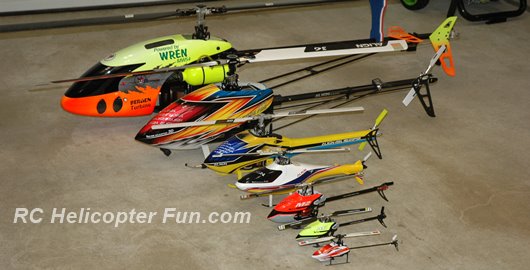
Radio Controlled Helicopters
Successfully Getting Started
by John Salt - Last Updated June 2024
So, you're ready to give radio controlled helicopters a go, or at least want to learn more about them to decide if you even want to give em a go.
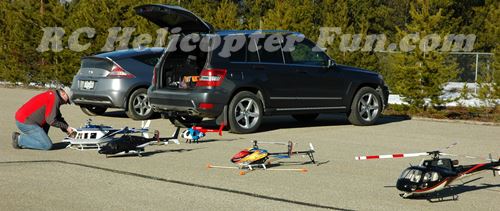 Radio Controlled Helicopters On The Flight Line
That's a great approach by the way (learn as much as you can first), and I hope my little heli site here is able to answer most if not all of your questions.
So, let's start right at the beginning assuming you don't know all that much about RC helicopters and the hobby yet.
When I am out flying radio controlled helicopters (abbreviated to RC), I often get asked many questions by people who stop and watch. Yes flying an RC helicopter usually draws a crowd.
 Flying a scale radio controlled helicopter
There are several common questions I always get asked, but let's start with the basics first.
The Four Main Types Of Radio Controlled Helicopters
- Toy (single rotor and coaxial)
- Micro Coaxial Hobby Grade
- Micro Single Rotor Fixed Pitch Hobby Grade
- Single Rotor Collective Pitch (3D) Hobby Grade (micro up to monster)
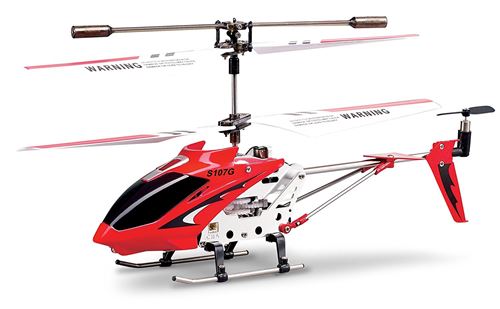
Toy radio controlled helicopters are exactly that, a toy. They are very basic and inexpensive. The controls are limited and not precise, but they are still fun and easy to fly.
A micro size toy RC heli can take quite a bit of abuse from crashes or from hitting objects because of the low mass & energy release. If you just want to get your feet wet and find out if you even enjoy controlling a small flying device by radio control, then a toy heli is a good starting point. I have a section devoted to toy RC helicopters - click here if you wish to learn all about them.
2. Micro Coaxial
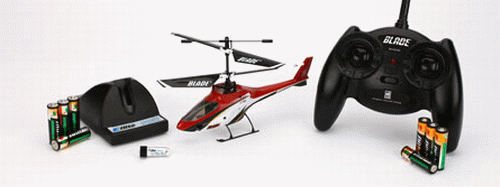
Micro Coaxial hobby grade radio controlled helicopters are the next step up in complexity, cost, and control ability.
First off, hobby grade indicates that many if not all of the individual parts on the helicopter can be purchased from a hobby shop and replaced.
This means when you crash or break something, the heli is not junk, you simply purchase a new part/s and your bird is good as new. The other benefit with hobby grade is that replaceable parts allow you to upgrade certain components to get better performance. A toy heli on the other hand comes as is, and if it breaks, that's usually the end of it and it's headed for the trash bin.
Micro coaxial hobby grade RC helicopters, also called dual or twin rotor helicopters start introducing real helicopter control - up, down, turn, forward, backward, sideways movement and of course hovering. Micro hobby grade coaxial RC helicopters are generally as easy to fly as a toy RC helicopter.
If you already know you'll enjoy flying a radio controlled model, and want good control over your RC helicopter yet still want an easy and tame flying experience, a hobby grade micro coaxial is a great way to start out. They are best for flying indoors because they can't handle any wind whatsoever. I have a section devoted to micro coaxial RC helicopters - click here to learn all about them.
It's worth mentioning hobby grade micro coaxial RC helicopters have in recent years become scarce and not many manufacturers are producing them anymore which is a real shame in my opinion.
The primary reason for this is because the latest generation of hobby grade single rotor fixed pitch RC helicopters (up next) are becoming almost as stable and easy to fly as a micro coaxial thanks to improvements in low cost electronic auto-level stabilization systems. However, single rotor fixed pitch RC helicopters are not as energy efficient as a micro coaxial and they don't have that same docile analog feel which is why I personally still enjoying flying a micro coaxial.
3. Micro Single Rotor Fixed Pitch Hobby Grade
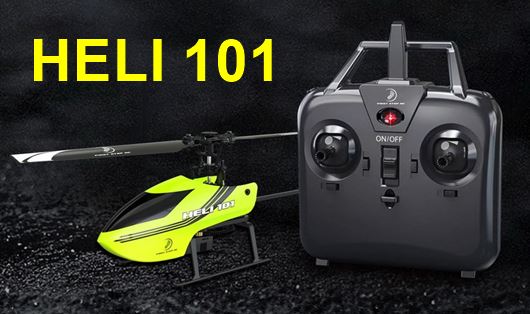
As just mentioned, these little micro single rotor fixed pitch hobby grade heli's are now becoming the next step up from toy RC helicopters since the demise of hobby grade coaxials.
Fixed pitch just means the rotor blades are held at a fixed angle; fully covered on my RC helicopter lift page.
Fixed pitch single rotor micro helis are slightly harder to fly than the micro coaxials, but still very stable thanks to auto-level electronic flybarless stabilization.
They can also handle light wind and are therefore a good option for both inside and out flying (on calmer days of course). With the demise of hobby grade coaxial RC helicopters, this new generation of electronically stabilized micro single rotor fixed pitch are what most serious beginners who want to take up the hobby start with.
In short, if you know you are going to like this hobby - these are a wonderful little helicopter type to start out on. I'm really impressed with the C129 / Heli 101 (pictured above) as a great first single rotor RC helicopter package for all ages.
4. Single Rotor Collective Pitch Hobby Grade

Now we get into real helicopter control, amazing performance potential, a larger time commitment and a deeper understanding of basic helicopter physics required to fly them.
The majority of my web site is focused on single rotor collective pitch RC helicopters because there is so much to learn about them, the equipment required to fly them, and of course how to fly them (covered in my flight school).
Single rotor collective pitch RC helicopters have the exact same helicopter controls as full size helicopters and in some respects are just as hard if not harder to fly as a full size helicopter.
You will often read & hear of collective pitch RC helicopters called 3D RC helicopters because they are the only type of RC helicopter that can maintain inverted (upside-down) flight, and can therefore do amazing aerobatic maneuvers which is fully covered on the how to fly 3D aerobatics page.
Now that you've seen what a modern day aerobatic 3D collective pitch RC helicopter can do (after years and years of practice), and the 4 basic types of radio controlled helicopters; let's get to the questions you likely have about getting into this hobby.
I usually get these five questions while I'm out flying any of my RC helicopters more than any others, let's take them order:
1. "What Does It Cost?"
Probably the single most common question I get asked is: "How much does a radio controlled helicopter cost?"
Well, it depends on many factors and what most people don’t understand is the helicopter is just one part of the total package; at least once up to the level of larger hobby grade collective pitch where you often have to purchase many of the components separately. In that case, a better question is: "How much does it cost to get into the hobby?"
Some of these items include:
- The RC Helicopter Kit
- The Engine or Motor
- The RC Radio / Transmitter
- The Servos
- The Flybarless System
- Batteries,
Charger, & Power Supply
if it is an electric helicopter
- The RC Field Or Flight Box
- RC Helicopter Training Gear
- Special Tools Required To Properly Build And Set Up A Heli
Again, that is for the larger, more complex hobby grade collective pitch RC helicopters where you often have to purchase all those items individually.
Thankfully the smaller toy and many small hobby grade ready to fly radio controlled helicopters which most people start out on now, come in complete packages including almost everything to get you going out of the box; that is why they're called Ready To Fly (RTF for short).
A brand new beginner to the hobby doesn't have to learn about all the various component first like we used to when I first took up the hobby back in the late 80's. Now you can get everything in one box, all built, and ready to fly.
With that understanding, here's a general cost guide-line for all types of radio controlled helicopters from small ready to fly toys, right up to large collective pitch/3D RC helicopter kits you have to build yourself. The prices listed are for a complete set up (helicopter, radio system, flybarless stabilization system, engine/motor, batteries, etc.) in USD.
Electric Power
- Toy: $20 - $60.
- Micro Coaxial Hobby Grade: $50.00 - $150.00.
- Micro Single Rotor Fixed Pitch Hobby Grade: $70.00 - $150.00.
- Micro Single Rotor Collective Pitch Hobby Grade: $130.00 - $300.00.
- Small Single Rotor Collective Pitch Hobby Grade: $300.00 and up.
- Mid Sized Single Rotor Collective Pitch Hobby Grade: $900.00 and up.
- Large Single Rotor Collective Pitch Hobby Grade: $1500.00 and up.
Fuel Power (ICE: internal combustion engine) - All Collective Pitch
- Mid Sized Nitro: $1200.00 and up.
- Large Nitro: $2000.00 and up.
- Large Gas: $3000.00 and up.
- Large Turbine: $8000.00 and up.
Remember – these are just very approximate numbers and you can spend many times more than this if you get top notch everything. On the flip side you can find good deals on older stock, sale or clearance items, used gear, or package deals.
This might seem like a lot of money for a hobby, but when you
look at what other hobbies cost, RC Helicopters like most other
endeavors can be as inexpensive or expensive as you wish. It all depends
on how serious you are involved in the hobby and if you choose to
purchase only brand new, high end, top quality gear over modest priced or used equipment.
Regardless, this hobby (like most) does require some disposable income. Both up front for equipment, and then afterward for operating costs, maintenance, repairs, and annual club fees if you join an RC flying club or RC flying registration fees which some countries now require.
2. "How Far, How Fast, How High?"
Next
to cost, these are the three most common questions I get asked while
flying radio controlled helicopters.
Let's start with how far and how high... There is no single answer to these "distance" questions because it depends on the type and size of radio controlled helicopter.
Size? Yes, size is the limiting factor across the board here since you can only control an RC helicopter if you can see it; so the larger it is, the further out and higher you can fly it.
Today's decent hobby grade radio equipment is generally good for up to at least a 1 km control range (about 3000 feet) depending on factors such as receiver type/placement (park fliers & micros will have less range), surrounding buildings/power towers, and atmospheric conditions (covered in detain on my RC Antenna page).
Even a very large RC
helicopter starts to become hard to see at 1000 feet away and once you
can't make out several critical identifying components on the heli such
as the body, the tail boom, the landing skids, and the almost near
invisible rotor disc; it gets impossible to see those main identifying parts of it to maintain correct and accurate control.
Lighting also plays an important roll here as well as the color scheme on your bird. Bright contrasting colors are easier to see so that will help extend your range slightly. Late in the day when the sun starts getting closer to the horizon or sets, visual range is reduced substantially since the heli gets darker and is silhouetted against the sky (same can be said for overcast days).
 Radio Controlled Helicopter Hard To See & Control When Far Away Or In Poor Lighting
This makes it near impossible to figure out which way the bird is flying and is very easy to lose orientation awareness (the number one cause of crashes for beginner to expert). How good your peepers are is obviously a big factor here as well. I know my 50+ year old eyes can't see as well as what my 20 year old eyes could and over the years, that has certainly reduced my distance and height flying envelope. The solution (at least the one I tell the wife) get bigger helicopters.
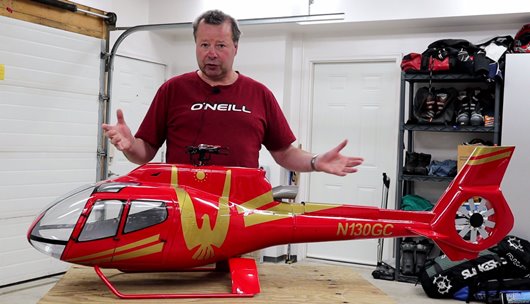 Serious hon, I needed this so I can see it.
So the simple answer here is you can fly a radio controlled helicopter as far away or as high up to the point you can't see what you are doing. You will lose practical visual acquisition range LONG before radio range in other words.
Speed is also dependent on the specific type and size of radio controlled helicopter. A small micro coaxial may only fly with a top speed of about 5 kph (3 mph) whereas I've clocked one of my larger collective pitch helis at over 150 kph (90 mph).
The radio controlled helicopter world speed record last time I checked was 319 kph (198 mph), accomplished by a speed specific designed Diabolo S speed specific collective pitch RC helicopter. Every year it seems we are inching closer to that illusive 200 mph number.
3. Do You Have To Know How To Fly RC Planes First?
Not at all! There are very limited similarities in flight behavior between helicopters and airplanes.
Experience with an RC airplane won't help you fly a radio controlled helicopter, but will certainly help you with things such as getting your engine running and tuning it. It will also help with the familiarity of RC radios, speed controllers and batteries.
Even RC car and truck experience will help. In fact, our RC car sisters and brothers probably have an advantage when it comes to building the helicopter, there are many similarities between the mechanical workings of RC cars and RC helis and how they are built.
Of course if you have no RC experience, that is okay to, you will just have a longer learning curve.
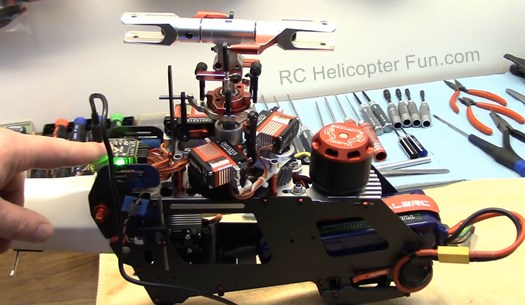 Building & Maintaining An RC Helicopter Is Half The Fun!
4. "Are Radio Controlled Helicopters Hard To Fly?"
No sugar coatings here – when you are first starting, single rotor collective pitch are exceedingly difficult. That's part of their charm, challenge, and long lasting appeal!
It's said that radio controlled helicopters are harder to fly than full size ones. I have talked to several helicopter pilots who fly both, and most will agree with that statement as it applies to actual control fineness of the helicopter.
However, the overall mental workload in full size is way harder. Here's a write-up I have done that explains in greater detail just how hard - or easy depending on your point of view.
This is the main reason why I built the How To Fly RC Helicopters section of this website. I don't want people to give up with RC helis simply because they didn't have someone to guide them through the basics of learning how to fly an RC helicopter.
You also have to understand some basic helicopter flight theory before you even attempt to fly a helicopter, although that is the same for RC airplanes.
Like I said before, learning how to skate or ride a bike seemed impossible for many of us, but once you got it, it seemed so easy right. Helis are no different – just more technical.
There are more tools now than ever to help you along the way such as RC helicopter flight simulators, and the equipment is much better. Learning from a qualified RC heli instructor is by far the best way to go; but many of us (myself included) learned on our own - self taught.
Almost anyone can figure it out. Some catch on quick, others take a bit longer – but if you take your time, understand the basics, learn in small steps from the ground up, practice, practice, practice, and have passion, there is no reason you can't succeed at this hobby!
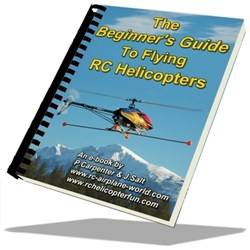
The Beginners Guide To Flying RC Helicopters is an eBook I offer to help the RC heli newbie navigate through the maze of radio controlled helicopter information in a logical and easy to read format. Click on the image if you wish to learn more about this beginner friendly RC helicopter eBook.
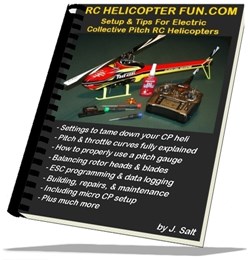
Setup & Tips For Electric Collective Pitch RC Helicopters is another one of my own eBooks that will help people who are starting out on collective pitch helicopters and want to learn how to tame them down into a good trainer platform along with many other tips for those first getting into the hobby.
Proper setup on a collective pitch heli is crucial - this eBook demystifies the process. Click on the image of the book to learn more about what's inside and how it can help.
5. "A friend of mine tried radio controlled helicopters, but gave up so I'm discouraged from trying?"
There are several reasons why many people give up or fail with radio controlled helicopters, the most common are:
- Not being compatible with the hobby. I talk more about this and what attributes most of us "heli heads" share on my about me page. This hobby simply won't be everyone's cup of tea. It requires patience, passion, practice, & perseverance! It's definitely not for those looking for instant success or gratification.
- Not purchasing the best RC helicopter for their needs.
- Not understanding basic RC helicopter controls and theory.
- Rushing the build and set-up process or not fully understanding the complexities involved.
- Rushing the flying process, if they even understand the steps involved in learning how to fly an RC helicopter. Successfully learning to fly an RC helicopter is a GROUND UP process. I unfortunately see way too many beginners trying to learn the exact opposite way and they keep crashing. Many then give up because repairs are frustrating and costly (both in time & money). There is no reason any beginner should crash their RC helicopter when first learning to hover if they follow a ground up learning approach and understand the basics; which brings us to the last point.
- Simply not having anyone to help.
Hopefully I and my website can take care of all but the first reason listed.
I built this website to offer sound advice and guide you along the way. I want people to succeed with radio controlled helicopters and enjoy this rewarding and fun hobby as much as I do - hopefully for a life time.
You may want to check out my Best RC Helicopter page next or the Are RC Helicopters Hard To Fly page as both are the usual next steps if you think you want to learn more about the hobby and take it up.
Good Luck & Have Fun!

Need Heli Help?
- Getting into the hobby but have no one to help you?
- Are you feeling overwhelmed & confused?
- Are you tired of wasting time seeking partial and conflicting information?
- Don't understand the maze of RC heli setup fundamentals?
- Is that sickening feeling after crashing turning you off the hobby?
- Are you simply ready to give up?
My RC Helicopter eBooks will help you with those exact problems. Grab your copies today.
Click Here For More Information
Click Here For More Information
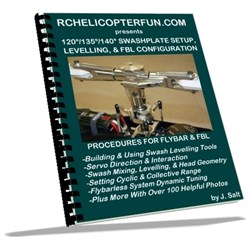
Click Here For More Information
 Interested In RC Airplanes Too? Save Money With The Beginner's Combo Package
Recent Articles


-
Large RC Helicopters - Micro to Monster & Best To Learn On!
Jul 03, 25 07:19 PM
 Large RC helicopters Used To Be The Recommendation To Start With Back When I Got Into The Hobby, But That Is No Longer The Case. Let's Find Out What's Best Now!
 -
LiPo Battery Balancing - Keeping Your LiPo's Healthy & Safe!
Jun 16, 25 05:21 PM
 LiPo battery balancing made easy. Why you need to do it, how to do it, and why it's so important for your LiPo battery packs.
 -
Mastering RC Helicopters - Your RC Flying Adventure Starts Now!
Jun 16, 25 02:01 PM
 RC Helicopters: Your first stop for fun! From toy to turbine, find expert help, tips, guides & more for this rewarding hobby.