Are RC Helicopters Hard To Fly?
by John Salt - Updated April 2025
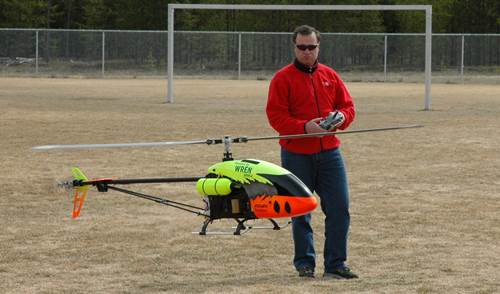 Collective Pitch Turbine Powered RC Helicopter
"Are RC Helicopters Hard To Fly?" is a question I get asked several times a week.
Such inquiries usually come from people who know how to fly RC airplanes, quad rotors and easer to fly 4 channel fixed pitch RC helicopters. They all want to know if single rotor collective pitch RC helicopters (also known as 3D) are as hard as people say they are to fly, and if so - why?
These folks simply want to know if they have the required skills to be successful in this hobby, while some are a little scared to take it up. As with most things, skills are learned, knowledge replaces fear, and almost anyone can learn to fly one of these eggbeaters - I'm certainly proof of that.
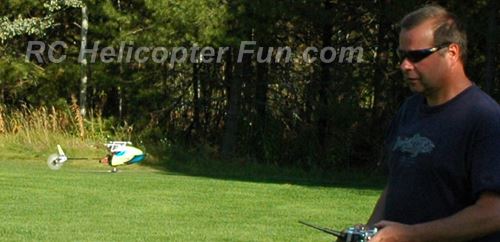 Still trying to master the inverted hover - what an awesome hobby!
Progressing to a 3D/collective pitch RC helicopter should not be scary as long as you understand a bit about them. It wasn't all that long ago, starting out on a large, expensive nitro powered single rotor collective pitch machine was the only option after all. It was possible then and with today's better equipment, even easier and much less expensive and intimidating.
The micro coaxials and micro electronically stabilized fixed pitch single rotor beginner type RC helicopters were break-throughs and continue to introduced so many more people to this hobby; but they do fly so differently over a true single rotor collective pitch bird. This can be a big problem and setback when people make the switch if they just think they will start flying a single rotor heli and it will be more or less the same as what they are used to on their or micro coaxial, fixed pitch single rotor, or quadcopter.
Crashing within the first 10-20 seconds is generally inevitable if you approach it that way.
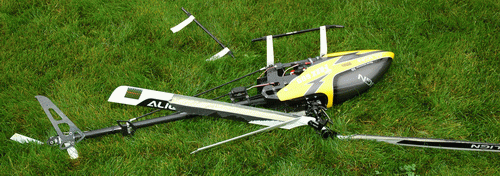 Don't Rush The Learning Process
Are RC Helicopters Hard To Fly? With Collective Pitch, Much Of That Depends On The Setup.
First off, any good single rotor collective pitch helicopter, coupled with a good computerized radio is very capable of becoming a nice docile trainer with the correct beginner settings - that is the first hurdle to get past.
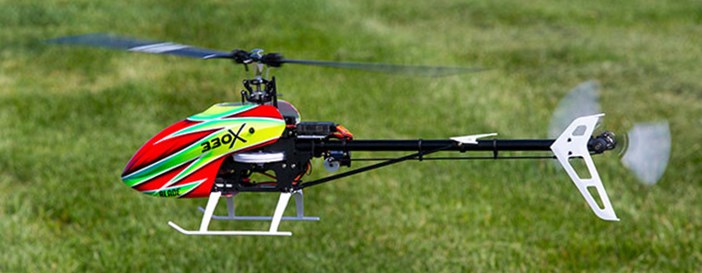 Tame And Docile Setup Makes Learning To Fly A Collective Pitch Heli Much More Manageable & Enjoyable
As long as you are learning in low to no wind, 100 to 400 size machines are generally the best to self learn on due to the lower cost outlay.
400's (300-350mm size rotor blades) used to be my standard go-to size recommendation because of the fairly long flight times per battery pack, and ability to easily see them; but all the new 100 to 200 size heli's like the OMP M1 & M2 are wonderful little helicopters that fly just as well with similar long flight times (with tame setups of course).
There is a fine line between
the added stability and improved visual footprint offered in a larger bird over the added fear of
crashing said lager machine due to the added repair expense after all.
This is budget driven of course and depending on the person's budget, may or may not be an issue.
Next is to understand the differences in how single rotor
collective pitch RC helicopters hover and fly compared to micro coaxials or fixed pitch single rotor helis with electronic stabilization auto leveling.

"Micro coaxial RC helicopters or RC helicopters with electronic auto leveling stability modes, behave like a ball bearing in a bowl.
As soon as you stop moving them around and center your cyclic stick, the heli will settle into a nice stable hover the same way the ball bearing will settle to the bottom of the bowl.

Single rotor collective pitch helicopters (full size and model) on the other hand without any electronic auto leveling help behave like that ball bearing if you flip the bowl upside down and now try to balance the ball bearing on the top curvature of the bowl."
That is a pretty good analogy of how collective pitch birds behave in a hover. It is basically a balancing act on a domed bubble of high air-pressure. The second you stop making cyclic corrections to keep it balanced on top of the bubble, the helicopter will start drifting away and accelerate fast; just as if the ball bearing on the outside of the bowl would start rolling off the top of the bowl down the sides the second you stop balancing it on the top of the bowl.
Now, the control certainly isn't as extreme as that, but it's a
nice way to illustrate the difference between micro coaxials & electronic auto-level stability compared to true
collective pitch single rotor RC helicopters which are much more dynamic and fun to pilot.

Here's a better example - the ball bearing is now on the outside of a plate.
This is actually a pretty accurate feeling of what a collective pitch RC heli behaves like while in a hover.
Holding onto the plate in both hands, put a ball bearing or marble on it. Keep it steady and then start moving the ball around on the backside of the plate. If you can move the ball in all directions and stop it whenever you want on the backside of the plate, you will get the basic idea of what controlling a single rotor collective pitch RC helicopter is all about.
Command input, helicopter reaction, counter input to stop movement (in two planes of direction no less). That's essentially what's going on the entire time while hovering. In short, unlike a stable micro coaxial or an RC heli with artificial auto-level stabilization turned on, a collective pitch helicopter is dynamically unstable while hovering. To maintain a state of hover equilibrium, any time you change one variable, it upsets that equilibrium forcing you to constantly keep making multiple control corrections - I call this "active piloting".
Of course you have to deal with other variables that are going on. The ball bearing/plate example only demonstrates the
cyclic control (pitch & roll), not
lift
or
yaw
; but cyclic is the hardest to learn and demands the most concentration when you are first starting out. As
I mentioned, if you have the right settings and right equipment to make
it as docile as possible so you don't over-control it, that is the key to learning how to fly
successfully.
It sounds hard and it is (at first). You basically start with ground hover exercises and work up to small hops, spending longer and longer times in the air. This is when your brain is creating new pathways to deal with all the new hand-eye & radio stick control coordination required. It's mentally exhausting at this stage.
Just when you think you'll never get it, all of sudden, something just clicks and you find yourself holding a steady, controlled hover. I have to tell you, it's one of the most amazing feelings & experiences that will happen in the world of RC.
Personally, it took me a week of daily practicing. That was having three 10 minute flying sessions per day so about 20 sessions or 3 hours total to achieve that eureka moment, but it was worth every second!
It's a feeling of pride and accomplishment that you'll rarely get with any other form of radio control.
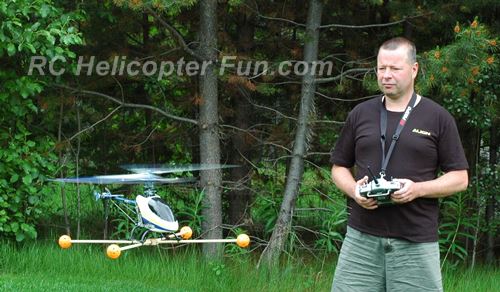 Your First, Short Controlled Hover Is What Usually Sets Off The "RC Heli Addiction"
What usually happens at this point is
you get so bloody excited, you lose focus, and have to land quickly to regain
composure. However, once you get that first small taste of a controlled hover, the addiction hits! There is no going back now :-)
After
several more hovering sessions, you'll likely be able to hold a tail
in hover indefinitely; not
even thinking about the many multiple control inputs you are naturally
giving
every second to maintain that state of hover equilibrium.
As I say many times, learning how to fly an RC helicopter is just like learning how to ride a bike, learning how to ski, learning how to skate, e-foil, or any other activity that involves precise balancing.
Remember how frustrating any of those activities were at first, and then just how fun they got once the light bulb finally went off. It just takes time and practice to get there. Of course the big difference with an RC helicopter is you can't "feel" when things are drifting off balance, you have to watch for them and make the required corrections via hand/eye coordination.
This is also why full size helicopter pilots say the RC models are harder to hover in many respects - "there is no feel".
Full size heli pilots are in constant communication with their birds feeling what the rotor disc is doing, how it's loading up, keeping an eye on the horizon and instrumentation, and of course feeling what is going on through the seat and controls. We don't get that immediate "feel" & instrument feedback flying a radio controlled helicopter, we have to watch the exterior of the helicopter for it and it simply takes time to learn, and in multiple orientations, but learn it you will.
The average time it takes a student to learn how to hold/maintain a solid tail in hover (no orientation reversal) is generally about one week if they have never flown a heli before or practiced on a simulator.
As I already mentioned, learning how to hover a collective pitch RC helicopter is mentally exhausting. An hour with several breaks in between is about as long as most people can handle before they start making mistakes. That time can usually be cut in half if you have been practicing correctly on a good RC flight simulator .
If you go through my Flight School section on my web site, you will get a pretty good idea of the time line and the steps involved. Those lessons are the same ones I use while instructing, and are based on MAAC's (Model Aeronautics Association of Canada) RC helicopter flight training program for all 3 proficiency levels (beginner, intermediate & advanced) .
By the way, I'm sure you may be saying to yourself at this point, "if collective pitch helis are so stinking unstable while hovering, why even bother, why not just stick with stable coaxials, or easy to fly RC helicopters with electronic auto level stabilization?"
The first reason I've already obsessed over - massive satisfaction. You'll never experience that wonderful high that all of us who have learned to fly a CP heli first experience; and then get to experience over and over again whenever we learn another collective pitch milestone.
The second reason is performance. A collective pitch RC helicopter becomes rock solid stable and smooth as glass once flying at speed not to mention the much better wind handling immunity. There is also the much better performance potential for faster flying, improved handling, and of course aerobatics making collective pitch so much fun that will rarely get boring for most people as the rewarding learning curve never really ends.
No question, collective pitch RC helicopters are not for everyone. If you have a short attention span, want instant fun/gratification, and simply don't have the time or desire to practice much at this particular juncture in your life, cross collective pitch off your list, at least for now.
I can't tell you how many people who have contacted me with collective pitch success stories after an initial failed attempt/s several years or even decades back. If the hobby is not right for you now or in your past, it very well may be later down the road. This holds especially true if you love helicopters.
The Challenge Of Flying A Collective Pitch RC Helicopter Is What The Hobby Is All About.
GPS Caution.
As you likely know by now, I equate learning to fly a collective pitch heli right up there with other very fun and rewarding activities that most of us have experienced in our lives; and why I consider the challenge of such activities vital to experience that overwhelming feeling of satisfaction and accomplishment.
This is why I, like most instructors, am not a fan of GPS autopilot on collective pitch helicopters for hovering & flying learning aids. To pass even the most basic RC helicopter proficiency tests so you are allowed to fly by yourself at most RC flying clubs, you can't use auto level help, never mind a GPS autopilot.
I cover the auto/self-level topic in more detail on the "should a beginner use auto level" page if you want to know more about those systems, which can be most beneficial when used correctly.
GPS Autopilot systems on the other hand require zero active piloting skills and form many hard to break habits. They are also bloody costly.
I simply don't see the point in using them - where's the challenge and engagement? Where are the eureka / light bulb moments that get you hooked? Why would you get excited about the hobby when the electronics are doing it all for you?
I know for a fact if I never had experienced that first hovering eureka moment, it's doubtful I would have stuck with the hobby because it was at that very moment when I became hopelessly hooked!
We are all different of course and for some, GPS autopilots will simply be the only way they will ever be able to enjoy flying a radio controlled helicopter.
But, they must know the dangers and limitations of such systems.
GPS autopilots when used as hovering and flying training aids end up taking a lot of the required piloting skill out of the equation and enable people with little training, the ability to fly a potentially dangerous collective pitch RC helicopter in situations they would never be able to get into without the electronic aids. This is dangerous and potentially detrimental to our hobby in my opinion - why?
It's pretty hard for a newbie RC helicopter pilot to get a CP helicopter flying long enough far away from his/her position to become a threat to others. As I said, most will crash within the first 10-20 seconds if they don't know what they are doing and forgo the "ground-up" learning curve.
GPS Autopilot however now allows the RC helicopter to get much higher and further away with the exact same beginner skill sets. This worries me and without some basic training or lessons before hand, I can foresee some serious crashes and property damage occurring and spinning a negative shadow on our hobby. I cover this problem in depth on my Drone Misnomer page.
And don't think you will never crash with a GPS autopilot, especially when first starting out before you learn how to correctly fly.
I have personally seen way worse & dangerous crashes with GPS enabled RC helicopters due to the massive energy release from newbies getting way higher and further away than safe RC flying demands. It's why our RC flying club won't allow GPS autopilot systems anymore - too many close calls.
I also get so many people contacting me for repair service and setup help after they crash their GPS autopilot equipped heli. In short, these things are obviously crashing often, be it from pilot error or system/component failure.
Conclusion
I hope that helps take some of the fear or mystery out of flying a collective pitch RC helicopter.
The adrenaline rush when you are spooling up never really fully goes away (at least with larger collective pitch helicopters) depending on how skilled you are and your experience level.
Flying a larger RC helicopter or plane generally produces adrenaline flow. The more you push your and your machine's limits, the bigger the rush. That's all part of the addiction for many.
It's heart breaking when you make a mistake, but absolutely euphoric every time you learn something new - be it your first hover, first nose in hover, first inverted hover, first auto rotation, etc...
The learning curve never really ends and that's the main reason this hobby is so addictive and has such staying power. Of course you don't have to push your limits with aerobatics; you can fly nice smooth style scale and for many, that has its own unique set of rewards and challenges.
In my own opinion, there is nothing more graceful or pretty as a buttery smooth flying collective pitch RC helicopter sporting a shinny scale fuselage. I honestly can't watch 3D aerobatic stuff for long, but I can watch a good pilot flying a scale bird all afternoon.
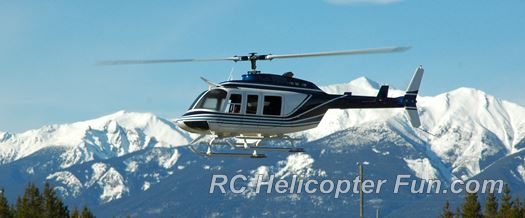 This is what the hobby is all about to me.
I've had some of my most enjoyable & memorable flying experiences flying my scale birds; always striving to improve my control inputs to mimic what a full size helicopter behaves like. That takes a whole different skill set that can be just as enjoyable as this fun winter scale RC helicopter flight demonstrates.
At the end of the day, the most important thing is you are having fun whether that means flying tame or insane; collective pitch allows you to do both or anything in-between all equally well. Just like full size aviation however, the more time you spend on the sticks, the better you get!
So, are collective pitch RC Helicopters Hard To Fly?
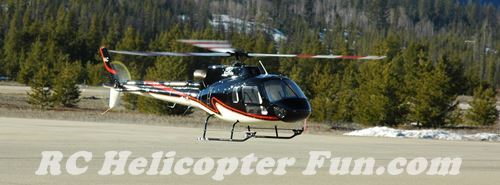 Scale Collective Pitch Flying Fun
I say they are actually fairly easy to fly, but difficult to master. I have never once met or talked to any RC helicopter enthusiast who told me they have learned it all and mastered the hobby. Why? Because there is no such thing as ever mastering this hobby.

Need Heli Help?
- Getting into the hobby but have no one to help you?
- Are you feeling overwhelmed & confused?
- Are you tired of wasting time seeking partial and conflicting information?
- Don't understand the maze of RC heli setup fundamentals?
- Is that sickening feeling after crashing turning you off the hobby?
- Are you simply ready to give up?
My RC Helicopter eBooks will help you with those exact problems. Grab your copies today.
Click Here For More Information
Click Here For More Information
Click Here For More Information
Recent Articles


-
Trex 450LP ARTF - For The Serious & Informed Beginner
Feb 27, 26 02:40 PM
 Align's Trex 450LP ARTF is perfectly suited to informed beginners who don't want to waste their time or money on a micro. Let's take a look at it.
 -
RC Nitro Fuel Tank Tips - Placement, Venting, Pressurizing, Filtering
Feb 26, 26 09:35 PM
 Let's take a peek at our nitro fuel tank and see what's important to ensure good fuel delivery for a proper running engine.
 -
Why Get The Blade mCX Anniversary Special Edition RC Helicopter?
Feb 26, 26 02:56 PM
 The Blade mCX Anniversary Special Edition remains to be one of the best micro coaxial RC helicopters of all time!