Blade 400 RC Helicopter Review
by John Salt
 The Blade 400 Was My Introduction To Electric RC Helicopter Flight In 2008
The Blade 400 RC helicopter (replaced by the 450X and now the 330X) are great 450 size collective pitch RC helicopters for people who are just starting out on collective pitch or perhaps just getting back into RC helicopters after many years.
Perhaps being intimidated by how much the hobby has changed over the decades with advancements such as electric flight, computerized radios, heading lock/flybarless gyros, and cyclic collective pitch mixing to name a few.
I too was in this boat after years of flying nitro, and I now look back at the Blade 400 as the helicopter that truly got me into & excited about electric powered helicopters.
I was so impressed after flying the Blade, I purchased one to share the experience. I was looking for one of the best entry level 400 size collective pitch RC helicopters to recommend for first timers on a fairly tight budget to start with.
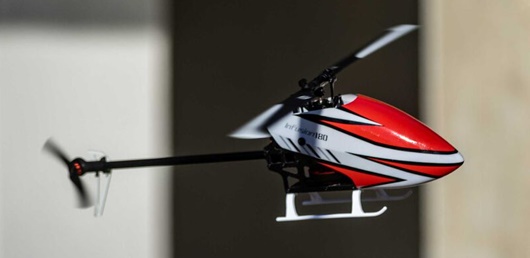
 My Blade 400 with Scale MD500 Fuselage Still Flying Like A Champ In 2025
A good quality heli package that they could grow with and one that would provide years of flying fun. I'm actually still flying my Blade 400 17 years later in a MD500E fuselage shown above.
It really was such a good RC helicopter for so many people. Yes, I'm hooked on electric flight now thanks to this little rascal and it was the perfect stepping stone to get into larger electric birds.
Lets get to the meat of the review I did way back in 2008...
There are several 400/450 size electric helis that I consider to be very good to learn and grow on. This means everything from your first ground hover exercises up to 3D if you take it that far. Value and quality were just as important if not more so. Remember value is not the lowest up front cost, but the long term costs associated with operating and maintaining the model.
The Align T-Rex 450 Pro Super Combo was certainly high on the list; in fact, if I was purchasing a 400 series heli just for me, the T-Rex 450 would be the hands down winner. I also was looking at Miniature Aircrafts Furion 450 & Mikado's Logo 400, but realized those are a little over the top for the beginner – performance and price wise. Other good 400's on the market that deserve a thumbs up include Thunder Tiger's Mini Titan E325, and Beam's 450 E4.
So why did the Blade 400 win out in the end? Three short words - “The Complete Package”.
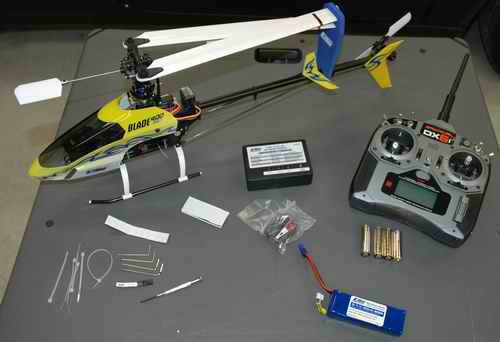 Blade 400 Ready To Fly Kit Contents
The T-Rex is without question a better quality heli, but it didn’t offer a complete package with a quality computerized radio, LiPo battery, charger, etc. and it costs almost twice as much as the Blade 400 by the time you get all those components.
Getting all those components and choosing the right ones can be intimidating and expensive for a heli newbie. Again, I was considering the first time purchaser on a budget and a complete package is more convenient and cost effective.
This pretty much pushes the Blade 400 to the top in terms of real value and bang for the buck for the collective pitch newbie. You know I am one for parts availability, and E-Flite’s parts support, just like Align's is simply outstanding – anywhere in the world. Parts support is important, but let's talk about about the crown jewel that comes with this bird - the Spektrum DX6i Radio.
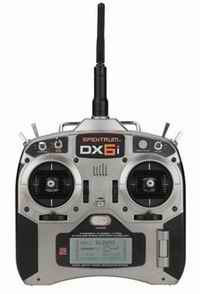 Spektrum DX6i Radio
I really like this radio ( click here for my review on it ).
The one touch scroll button is so much better than the up, down, and enter buttons on various other computerized radios. The DX6i also displays pitch and throttle curves graphically, the Futaba 6EX (Futaba's entry level computerized radio) doesn’t. If you read my RC Helicopter Radio page, you know why this is so important and why having a computerized programmable radio is also important.
Once you get into quality collective pitch single rotor helicopters, the radio is just as, if not more important than the helicopter - even more so for beginners. This is also why I didn't include or consider models like E-Sky's Honey Bee King 2, Belt CP, or similar models with toy like, non programmable radios.
WHY?
SETUP IS EVERYTHING! Being able to adjust the throttle and pitch curves to tamer values when learning to fly a collective pitch heli is crucial to your success. With the advent of electronic CCPM swash mixing , doing this the "old fashion" way by adjusting servo arm and push rod lengths to change the travel limits is not possible because of the inherent swash plate variation issues that come into play and overall loss of cyclic movement if you reduce collective. Electric power also requires changing throttle output rates (throttle curves) to correctly produce the correct power for a given main rotor pitch angle or at least smooth out the throttle response for less torque induced yaw.
Add to that the issues of setting up and leveling a CCPM swashplate correctly . I honestly know no other way to achieve a correct & level CCPM swash setup without using a computerized radio.
So yes, there may be 400 size helicopters out there that cost a hundred bucks or so less than the Blade 400, but you are not getting a computerized programmable radio with them. Once again I can't stress how important this is when getting into collective pitch RC helicopters.
From a pure growth potential the Spektrum DX6i is hard to beat. Any good computerized radio will have model memory now a days and can be used for helis and fixed wing aircraft. The neat thing Spectrum/JR are doing is building the ground work for an entirely new aspect to this hobby – Bind & Fly. This simply means any compatible DSM2 RFT model like the Blade mSRx , 120 SR , or the Blade mCPx can all be flown with a single Spektrum/JR DSM2 computerized radio. As more and more Bind & Fly models are offered, this is certainly something to consider for future growth in the hobby, saving you time and money.
Blade 400 Heli Features & Specifications
DX6i radio aside, there are many outstanding features that this little 400 boasts:
- Auto Rotation Capability – Yes
- Bearing Count – 30
- Bell Mixing – Yes
- eCCPM – Yes 120 degree
- Main Frame Material – Plastic / Tail boom – Aluminum
- Rotor Diameter – 718mm
- Tail Rotor Diameter – 135mm
- Tail Rotor Drive – Belt Driven
- Weight with battery – 665g Installed Components:
- Motor – E-Flite 420Heli brushless 3800Kv
- Electronic Speed Controller – 25Amp
- Receiver – Spektrum AR6100e 2.4 GHz DSM2
- Servos – 4 E-Flite DS75 Digital Coreless Micro
- Gyro – E-Flite G110 Heading Hold – Yaw Rate and Gain Remotely Adjustable. Other Items Included:
- E-Flite 11.1V 1800 mAh 20C 3cell
RC LiPo Battery
- Good Quality DC Li-Po battery charger/balancer –12VDC input, 3cell balancing, 1.8 amp charge rate. Many “included in kit” chargers are not that good, especially balancing ones. This one is actually not too bad. It has a cooling fan and the balance voltage readings are consistently precise with less than 0.02 of a volt between cells. You of course can’t adjust the charge rate or see the charge capacity like you could with a good quality computerized charger, but when you are just starting out – this little E-flite 3 cell LiPo charger works adequately.
- Small Tool Package
- Extra Gyro Mounting Foam Tape
- Blade Holder
- Instructions of course (basically a book for the DX6i Radio) but it is fun reading!
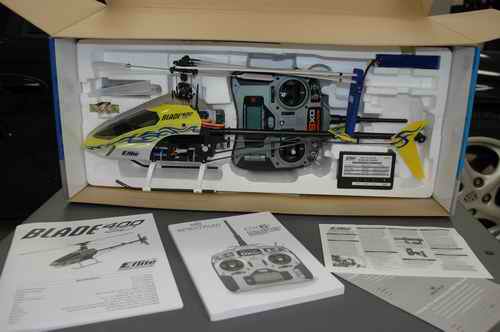 Blade 400 Unboxing
Flying The Blade 400
Features and specs are nice to know, but you can get those anywhere. What you really want to know is “how does it fly?” I was curious myself; but most importantly, I wanted to see for sure if this was a single rotor hobby grade RC helicopter I could recommend to newbies and experienced fliers alike...
Absolutely without a doubt - YES!
 Nice & Smooth Blade 400 - This Is What Flying RC Helicopters Is All About!
Out of the box the Blade 400 was in perfect trim just as they claim. This was a first for me. I have never been able to pick up the controls to any RC helicopter the first flight and have no trim adjustments – obviously E-Flight doesn’t lie about every model being flight tested and trimmed.
The throttle and pitch curves are set up for sport flying in standard mode and 3D in advanced mode. I am no 3D pilot so the first thing I did was tame both those curves down. The sport curve is good for sport flying and scale flying, but for someone just starting out – it is way too aggressive.
After several test flights, I came up with and programed in the perfect pitch and throttle curves to tame this agile little machine down into a great trainer. I also came up with some very nice dual rate values that further improve the trainer like settings. With the tamed down settings, the 1800 mAh battery was giving flight times of just over 11 minutes with scale type flying. This was the first big surprise seeing that the instructions indicate a 4-5 min flight time – obviously this is given on the 3D settings at full power.
Now that I had the perfect training set up, I thought I should see how the Blade 400 dealt with a set of Johnny’s home built training gear . This again was to see if I could recommend the Blade 400 as a very good first collective pitch RC helicopter.
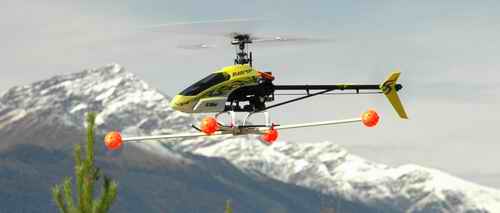 Blade 400 Fitted With Custom Built Training Gear
The 400 became even more stable once the additional weight of the training gear was added. I had expected it, but not to this extent. With the training gear on, my T&P curves, and dual rate settings I had entered, this little electric was starting to feel as stable and predictable as a much larger electric or nitro bird.
I really can’t get over how stable a 400 size can be with the right settings. Even with the added weight of the training gear on, the climb out rate is very impressive – better than most nitros I have flown with training gear on. You know what I was thinking – yup, this little bird will handle a scale fuselage no problem with the reserve power and flight times it was boasting.
Ok – how about sport flying. Take that training gear off, and switch to sport mode, time to start shaking a bit (me, not the heli).
I should start off by talking about the G110 gyro . The G110 is a full function heading hold gyro with remotely selectable gain and yaw rate modes.
The G110 is more than acceptable for the first time collective pitch heli flyer and has a solid tail lock, even in substantial crosswinds. Fast pirouettes stopped on a dime with no tail wag – perfect gain settings from the factory.
The stock DS75 digital servo on the tail rotor works fine for general flying, but it is slow to react when you start pushing sport or light 3D flying. Aggressive climb-outs will cause noticeable heading deviation as the slower DS75 servo catches up and corrects for the heading change.
Upgrading to a faster tail specific tail servo makes such a huge improvement over the stock DS75. As I said, it is fine for when you are just learning, but to get the most out of the G110, you need a 0.06-0.08sec/60 degree fast digital tail servo out back.
The G110 gyro does exhibit a small amount of drift throughout the flight as it warms up, cools down, or experiences voltage fluctuations; but again, for a low cost entry level collective pitch helicopter, the G110 is a good pairing despite the drift issues.
I only had to give a few clicks of rudder trim at most to sort out any drifting that was occurring - certainly not up to the performance standards of a Spartan Quark gyro, but for the price - adequate for the day (poor by today's standards however).
I was a little concerned how hard a smaller 400 size helicopter would be to see while flying large fast circuits. The high visibility yellow pod and tail fins really do a good job improving overall sight contact.
 The Yellow Canopy On The Blade 400 Helps Visually At A Distance
Flight performance is fantastic in sport mode with an impressive power to weight ratio along with predicable execution of loops, rolls, flips, and pirouettes every time. It's a very nice little heli when you are ready to start trying your hand at aerobics and for me, it was the main reason I got back into this type of flying.
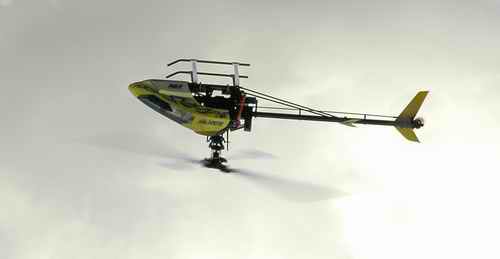 Going Inverted With The Blade 400 - No Drama...
This really boils down to a cost thing - a moderate crash on any of my other larger birds will easily set me back several hundred dollars. Blade 400 parts on the other-hand are inexpensive and easy to get. It's hard to rack up a $50 dollar repair bill on the Blade 400 in a moderate crash (assuming you don’t cake the LiPo battery in the process).
Like all 400 size helis, the Blade 400 gets a little tricky to fly when the wind picks up. The heli is so light, the translational lift changes bounce it around quite a bit. The added weight of training gear or a fuselage will certainly tame things down, but any sort of wind, especially a gusty wind when you are learning should be avoided at all costs.
After owning and flying the Blade 400 for over 12 years now with hundreds of flights and very little in the way of problems or much needed maintenance, I am more than impressed with the overall longevity. This is after all an entry level 400 size collective pitch RC helicopter that despite the low cost, is holding up very well.
What I Didn’t Like About The Blade 400
As good as this little bird is, there are a few minor issues I have with it.
First off, it is only available in a RTF (ready to fly) kit. There is no option of building it yourself (something I think is beneficial). I know this is market driven as almost every other "entry level" 400 bird out there are all pre-built and pre-flown. We live in an instant gratification society after all. I do however look at this in a new light since I got this RFT kit.
It was pretty nice being able to take this wonderful looking little heli out of the box, read the manual while the battery was charging and then go flying. Seeing that I keep saying I want people to succeed with RC helicopters, a RTF kit that has been flight tested does take much of the improper build and set-up problems associated with first time crashes out of the equation. For that reason, I do now see the value in a RFT test flown kit for the first time heli filer.
The supplied tools, just
like the tools in every other kit on the market are pretty poor in
quality. The Allen drive keys are very soft and round out easily, as
does the small Phillips screw driver. This is compounded by the fact
that the thread locker used on some of the screws and set screws is very
strong.
If you are having trouble and not quite sure what all the "setup" stuff is, feel free to have a look at my Setup & Tips e-Book for RC helicopters.
This e-book explains setup, why it's important and has all the setup values that I just talked about, as well as many tips and procedures to get the most out of your Blade 400 or any other electric collective pitch heli.
Click on the book image to the right if you wish to learn more about what's inside.
To help save you a little more money, I have written a “How To Build Your Own Training Gear” e-Book .
This is a fully illustrated instruction book that teaches how to build your own set of training gear.
If you want to read more about what's inside, just click on the image of the book to the right.
I'll leave you with a short video of the many features that the Blade 400 heli RTF kit has.

Need Heli Help?
- Getting into the hobby but have no one to help you?
- Are you feeling overwhelmed & confused?
- Are you tired of wasting time seeking partial and conflicting information?
- Don't understand the maze of RC heli setup fundamentals?
- Is that sickening feeling after crashing turning you off the hobby?
- Are you simply ready to give up?
My RC Helicopter eBooks will help you with those exact problems. Grab your copies today.
Click Here For More Information

Click Here For More Information
Click Here For More Information
 Interested In RC Airplanes Too? Save Money With The Beginner's Combo Package
Recent Articles


-
What's The Best Flybarless System / Flight Controller In 2025?
Jul 25, 25 07:05 PM
 Looking for the best flybarless system? Let's look at what's out there, pros & cons, features and pricing, to help you narrow your list.
 -
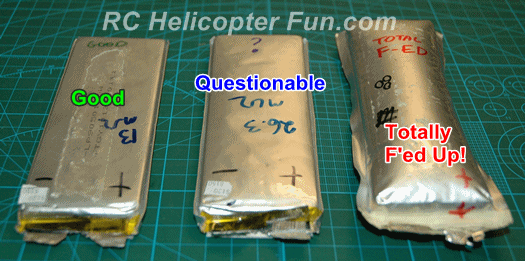
Puffed LiPo Battery? Oh-No! Is it still safe & can it be fixed?
Jul 19, 25 08:01 PM
 Puffed LiPo questions I get asked include what causes a LiPo to puff, can they still be safely used, and can you vent them? Here are my answers.
 -
Are Blade Helicopters A Good Brand To Start With & Why?
Jul 18, 25 03:21 PM
 Why are Blade helicopters such a good brand to start with when the market is literally saturated with entry level RC helicopters? Let's find out.