Choosing Your Airwolf RC Helicopter
by John Salt - Updated August 2026
A raise of hands...
How many of us got into the hobby, or are thinking of getting into the hobby, because of our attraction to the modified Bell 222 helicopter used in the 80's TV series Airwolf?
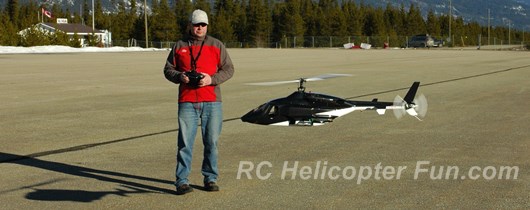 Having Fun Flying My Airwolf RC Helicopter
No question, the Airwolf helicopter was a big contributing factor back in my teens that eventually got me interested in the hobby. I flew RC airplanes at the time and had no plans of getting into RC helicopters; but after seeing that "wolf" flying on the TV every week, I started getting really interested in the helicopter side of RC flying.
I was eagerly reading every RC helicopter magazine I could get my mitts on to learn as much as I could. How I wish this website was available then :-)
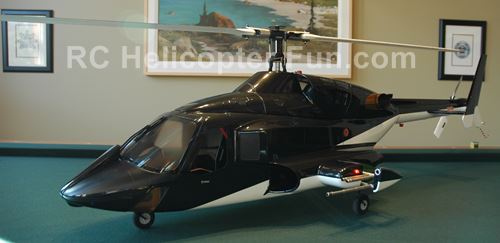 600 Size Airwolf RC Helicopter Build Finished
It was however almost 25 years after I started flying RC helicopters that I finally built my first Airwolf. Lots to learn in this hobby first before even considering such a model, and most are not cheap! Most other RC Airwolf owners/fliers I've talked to around the world have similar stories; slowly working their way up to purchasing, building and flying one.
This is in sharp contrast to what many newbies think who have little understanding of the hobby (yet). How many times I get asked "how much" and "where do I get an RC Airwolf like the one you fly?"
Thinking you can just purchase a large ready to fly model like that, not understanding they only come in kit form and require considerable experience to build and fly. No mention of course of the most important question - "how hard is it to fly an RC helicopter" and "what I must learn first before considering an Airwolf model?"
Airwolf RC helicopters are scale RC helicopters and before you even consider getting an Airwolf, you should be very familiar with building and flying scale; or at minimum have a good grasp on what scale RC helicopters are all about.
With that said, there are now a few easy beginner RC Airwolf options. So, let's start at that "Airwolf beginner level" and move up to more advanced RC Airwolf models to cover the entire spectrum based on flying skills, building/modelling experience, size of helicopter, and budget.
Beginner Airwolf RC Helicopter
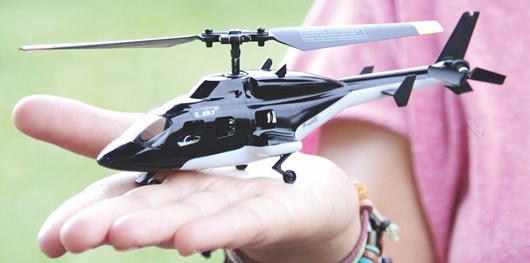
The Esky F150 V3, is possibly the best micro Bell 222 on the market right now, and is quite easy to fly for beginners thanks to the micro sized CopterControl CC3D electronic stabilization which utilizes 6 sensor stabilization (3 gyros & 3 accelerometers).
This little Airwolf inspired Bell 222 uses the very good, robust, and proven Esky 150 V3 RC helicopter as the base mechanical and electronic layout.
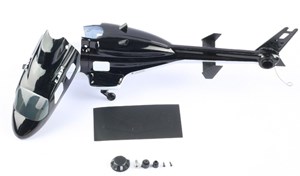 Esky F150 Airwolf Replacement Body
Then it's covered with a fairly decent looking, light-weight polycarbonate Bell 222 body / fuselage with the Airwolf color scheme.
It doesn't have the Airwolf body modifications however such as the turbojet engine housings on the side winglets, covered rear windows, and raised nose cowling.
For a micro however, the detail is not too bad.
I talk all about the F150 helicopter in my review of it, if you want to learn more about the 150 V2 & V3 and what makes them such great fixed pitch micro RC helicopters for beginners (one of the best in this size currently on the market in terms of flying ease and robustness in my opinion).
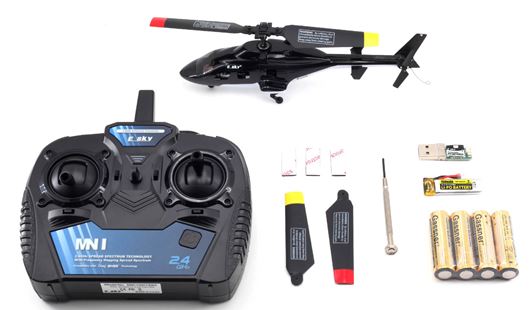 ESky Airwolf F150 V3 RTF Package
As shown here, the Esky F150 V3 airwolf comes in a ready to fly (RTF) package, and has everything needed to get you flying.
Do note however the landing gear (wheels), are not retractable like seen on the full size Airwolf/Bell 222 and more advanced Airwolf RC helicopter models.
GPS Airwolf RC Helicopter

Next step up in both size and complexity are the self-flying GPS Airwolfs.
Anyone who knows me or has spent anytime on my website, knows my thoughts as an RC helicopter enthusiast and instructor about self-flying GPS autopilot RC helicopters - I detest them because they are bad for our hobby and RC aviation in general.
Nothing changes in that respect for a few of the GPS Airwolfs on the market such as the ready to fly Flywing 400 size GPS Airwolf and absurdly costly mid (500) sized FlishRC GPS Airwolf .
More of these overpriced things have been crashed and sent to the landfill than just about any hobby grade RC helicopters in recent history because the vast majority of people who get these dangerous things don't know a thing about the hobby, have no prior RC helicopter experience and therefore have no idea how to safely fly and repair them after crashing. Going by how many times I'm contacted - they are crashing often.
Anecdotally, the number of emails I get asked about repair and setup help on all of Flywing's self-flying GPS helicopters account for more than every other brand and make of conventional RC helicopter combined. Incidentally, I don't offer any online help with GPS helicopter repairs/setup because they are impossible to sort remotely; they are hard enough to get flying correctly again in person.
Rebuilding any collective pitch RC helicopter after a crash requires systems knowledge and setup experience, never mind one with a GPS autopilot system. Now lets add the increased mass, component access complexities, and fragility of a scale fuselage into the mix. These GPS Airwolf RC helis are a money pit disaster waiting to happen the moment they are removed from the box. Moreover, they have short parts support life, overflowing with built-in obsolescence.
How about how lousy they fly? The poor tail hold, yaw authority and consistency while not even being able to perform the most basic of flight maneuvers we all saw the full size Airwolf perform every week on TV such as the famous hammer head turn just scratches the scale heli performance let-downs.
I should point out, no GPS RC helicopter can come close to replicating full size helicopter behavior due to the robotic nature of GPS autopilots. They are not fluid or graceful, they don't "skate" in the sky like full size and conventional collective pitch RC helicopters and none of them will allow you to manage rotor energy to mimic full size helicopter behaviors and hone your unique scale flying style.
With all that said, if you are the sort of person who wants to control a larger than micro size RC Airwolf helicopter but have no time or desire to learn how to correctly fly a collective pitch RC helicopter, then a ready to fly GPS RC Airwolf helicopter is your only option. At least now you know the drawbacks so you're informed going in.
Collective Pitch Airwolf Fuselages
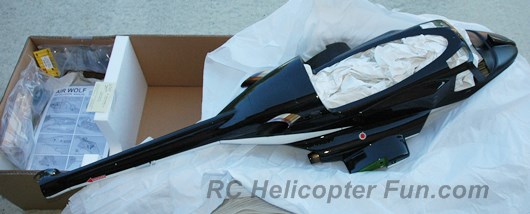
Next up in the RC Airwolf helicopter experience and skill level is the scale fuselage route.
This option allows you to purchase the correct size Airwolf scale fuselage to fit over a set of collective pitch RC helicopter Pod & Boom mechanics; preferably ones you have already flown many times to work out any mechanical/electrical bugs, tune, and are fully confident in.
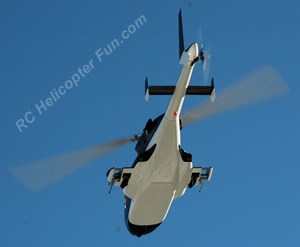 I love the look of the Airwolf's belly!
Unlike the aforementioned micro and GPS wolfs, this Airwolf option is only practical if you already have collective pitch RC helicopter flying experience and some scale heli building experience.
In short, you must be able to build and fly a collective pitch RC helicopter and fly it well!
You certainly don't have to be a hot shot aerobatic, F3C or 3D pilot. You should however be able to fly upright circuits in all orientations and very rarely crash.
I explain all of this on my scale RC helicopter page in much more detail if you want the why & hows of this.
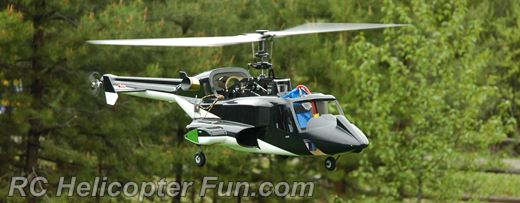 Unfinished Airwolf RC Helicopter Test Flights
Other than little easy to fly beginner fixed pitch micro and self flying GPS autopilot RC helicopters, getting a fuselage and fitting it to pod & boom mechanics is the most common and popular type of Airwolf RC helicopter most of us enthusiasts fly (myself included). The size range of these fuselages will range from small 250's, all the way up to large 700's.
They can be of any power type (electric, gas, or nitro), but these days electric is king (clean, vibration free, sound good). Price range and complexity is vast! A smaller 250 size Airwolf fuselage may only cost around $75 USD (fuselage only), while the larger ones can climb to well over $600 USD. Again, that is fuselage only - no mechanics or electronics.
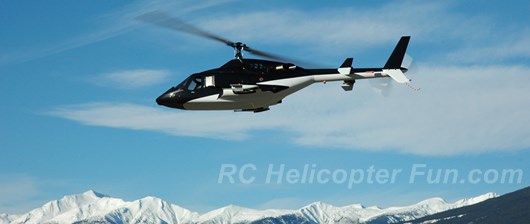 Enjoying My Airwolf With Mountain Backdrop
Take into account your pod and boom helicopter you already fly that you'll be putting inside your Airwolf fuselage. Finished flying costs of a collective pitch Airwolf RC Helicopter in other words can range from $500 USD to upwards of $5000 USD. This is why I suggest you have to be a fairly competent RC heli pilot by this stage in the game and rarely crash.
A crashed scale heli fuselage is pretty much a write-off because they are fragile, and Airwolf's are even more so because of the retractable landing gear and other scale details such as the side pod guns, missile pod, etc.
Additionally, an Airwolf (Bell 222) usually doesn't make the best first scale RC helicopter project. They can be rather challenging builds due to the tight spacing and retracts, but of course much of that depends on your building abilities, natural skill sets, and experience level.
Below is a video I made showing the basics of what's involved in a fairly typical scale Airwolf / Bell 222 fuselage build to give you an idea of the process.
There are several manufacturers of scale fuselages for RC helicopters, but the ones I like best for 550 to 700 size mechanics are FunKey's. That link takes you to a review I did on them to explain why they are so good along with links to purchase any of them, including the three Airwolf sizes they offer:
- 30/550 Size
- 50/600 Size
- 60/700 Size
I currently fly the FunKey 600 version myself, which is the one shown
in that build video above. FunKey also paints their Airwolf in a fairly
accurate shade of phantom grey metallic. It's a slightly darker shade
however from the original Dupont Imron 5031X.
Roban
is another popular brand and has Airwolf fuselage sizes in both 500 & 600. Paint & fiberglass quality of Roban's fuses are not as good as
Fun-Key's, but for the price, they are not bad either.
There are other smaller (450 size) Airwolf fuselage manufacturers out there as well, but I honestly have no experience with them.
Having some Airwolf RC flying fun below...
Roban Super Scale Airwolf RC Helicopter
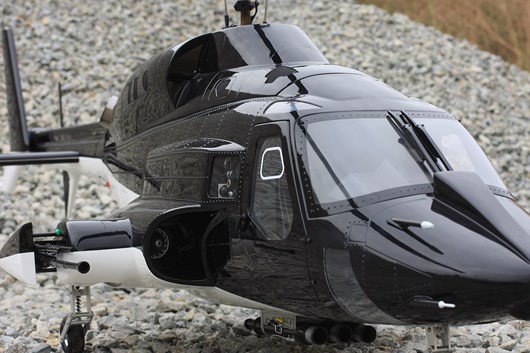
If you have deeper pockets, and want a large Airwolf RC Helicopter with a full scale interior that boasts a high level of exterior details; Roban's 800 size Super Scale Airwolf is pretty hard to beat for the price.
Like the fuselage Airwolf build options, this model also requires a strong level of collective pitch flying experience; large collective pitch heli experience even better so you know about the odd things that big heavy RC helicopters experience (vortex ring state comes to mind). Having previous scale building experience is also highly recommend.
However, unlike the fuselages that you put your existing pod & boom mechanics into, Roban Super Scale kits include the mechanics that are purpose designed for their specific scale helicopter fuselage. This can make fitting the mechanics much easier since all the spacing / mounting has been done for you eliminating the need to mod the fuselage or mechanics.
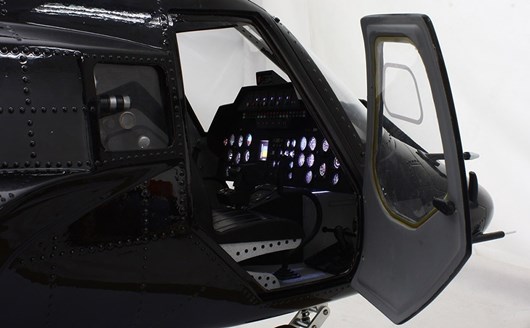 Roban Airwolf RC Helicopter Scale Interior Including Backlit Instruments
These customized scale RC helicopter mechanics are also what allows for full scale interiors since the majority of the mechanical and electronic flight components are positioned aft of the main rotor shaft.
I fly a Roban super scale AS350 and did a review on it along with their 800 size EC130 (unboxing video), if you are curious about Roban's super scale series. They are not the Airwolf version, but there are many similarities between all of Roban's 700/800 size Super Scale helicopter kits since they all use the HSM 800 mechanical platform.
Price wise, the Roban 800 super scale Airwolf is about $2500 USD for the fuselage and mechanics. You still need all the electronics (radio system, servos, flybarless controller, motor, ESC, and LiPo flight batteries. Expect finished flying costs in the $4000 - $5000 ball park (component & accessories dependent).
Vario's Turbine RC Airwolf
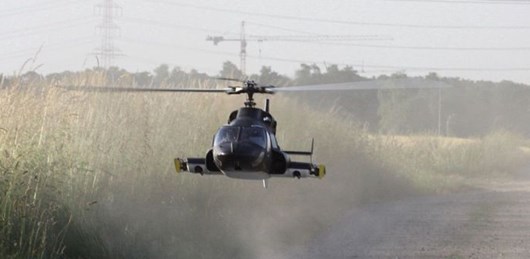
The turbine powered Vario Airwolf is what most of us can only dream about. Well, I suppose a full size Airwolf modded Bell 222 would be up there too in the dream department.
Vario Helicopter is tops in this hobby when it comes to big scale RC helicopters. Any time you've seen a large scale RC helicopter on YouTube, especially if it's turbine powered, pretty good chance it's a Vario bird.
At 1:5 scale, Vario Helicopter's turbine Airwolf is spinning 1050mm long rotors, making it the largest Airwolf RC helicopter mentioned on this page, and perhaps the largest RC Airwolf model that is commercially available anywhere in the world. It's also the only scale RC Airwolf on this page that is not pre-painted requiring customized finishing and the highest level of RC modelling skill to get flight worthy.
Vario offers several different mechanic options for their big Airwolf fuselage depending on what model turbine engine you choose for it. Fuselage cost is in the $3000 USD range, mechanics costs also in the $3000 range, and turbine engine costs in the $3000 range as well.
Add in electronics, rotor head & swashplate, rotor blades, turbine fuel systems, scale heli jet exhaust system, other mechanical bits, and a seemingly endless list of additional scale options, and it would not be too difficult to see the finished flying costs climb well north of $15K USD.
It's certainly a fun scale build to dream about, but very doubtful it will go any further than a dream for yours truly. I do fly an 800 size pod & boom turbine powered heli and change of underwear potential is already high enough with it. Can't imagine something costing over 3 times as much, with many hundreds of hours invested in build time. Not to mention the wife's financial logic coming into play - no way mister!
Here's the Vario turbine Airwolf in action!
 Having Fun With "The Wolf"
About the Author:
Hi, I'm John Salt (RC helicopter enthusiast and flying instructor). I've been building, flying, and helping people successfully take up the hobby of RC helicopters for over 35 years.
My goal is to take the mystery out of this amazing hobby so you can save time, spend less, while having more fun and success. Want to see my full story? Head over to my About Me Page.

Need Heli Help?
- Getting into the hobby but have no one to help you?
- Are you feeling overwhelmed & confused?
- Are you tired of wasting time seeking partial and conflicting information?
- Don't understand the maze of RC heli setup fundamentals?
- Is that sickening feeling after crashing turning you off the hobby?
- Are you simply ready to give up?
My RC Helicopter eBooks will help you with those exact problems. Grab your copies today.
Click Here For More Information
Click Here For More Information
Click Here For More Information
Recent Articles


-
What Makes OMPHobby RC Helicopters So Good & Should You Get One?
Aug 24, 26 03:01 PM
 OMPHobby RC Helicopters are designed to last! Easy to see, robust, impressive engineering, great parts support and much more.
 -
RC LiPo Battery Storage - Keep Your LiPo's Safe & Healthy
Jul 23, 26 07:51 PM
 Why is RC LiPo battery storage so important? Easy, it extends battery life saving you money plus increasing storage safety.
 -
RC Helicopter History - Vintage Gear & Costs
Jul 23, 26 07:18 PM
 Interested in RC Helicopter History? We all have Dr. Dieter Schluter to thank. Let's look at RC eggbeaters from yesteryear.