RC Rotor Heads - Bell Mixing vs. Hiller Mixing
by John Salt
To understand what Bell mixing is and how it works, we must first understand the differences between the two basic types of rotor heads that are used on most RC helicopters today...
The Bell Rotor Head, and the Hiller/Bell Mixed Rotor Head.
Bell Rotor Head
The Bell rotor head has no flybar; this is what is used on most full size helicopters and in the RC heli world is often called a "flybarless" rotor head. The inputs from the swashpate go directly to the main rotor blades for fast and direct response.
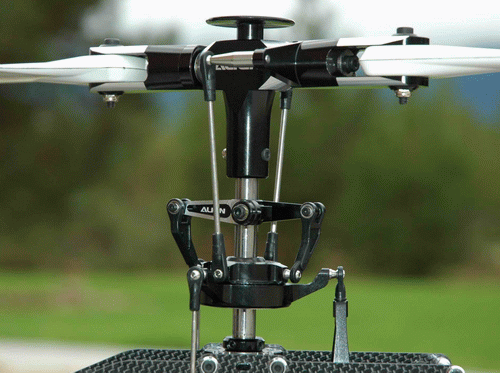 Bell Rotor Head
In the above photo, notice the pushrods go directly from the swashplate up to the main rotor blade mounts just like on most full size helicopters.
There is no dampening and no self correction offered from a flybar. This makes a Bell rotor head very sensitive - too sensitive in most cases for smaller size RC helicopters unless a flybarless stabilization system is used. There are also greater amounts of force on the cyclic servos because they have to be doing all the work in trying to change the pitch angles of the main rotor blades by themselves.
On a flybared helicopter, the flybar helps move the main rotor blades as well as the servos. Not really an issue with the digital, higher torque servos available today, but it's worthwhile noting in case you were upgrading to a Bell head, but didn't have very strong servos on your helicopter.
Bell heads on RC helicopters can also come in a few different flavors such as DFC or Driverless for example.
You will often run across Bell rotor heads being used on multi-bladed scale RC helicopters for added scale realism.
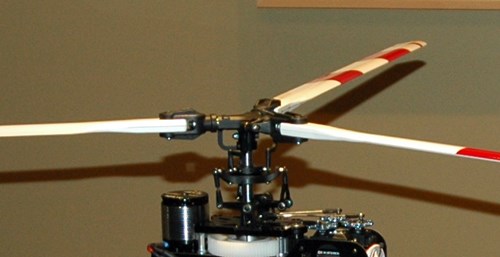 Three Bladed Bell Rotor Head
Having more blade mass with a multi-bladed head will dampen cyclic response a fair amount, and it actually is very possible to control a multi-bladed Bell rotor head without any electronic stabilization help. That said, it still poses certain challenges such as ballooning and lack of overall stability.
I've flown a couple multi-bladed Bell heads without a flybarless system and although it's very doable, it's far from enjoyable. Without question, the majority of scale pilots today flying muilti-bladed heads will use electronic stabilization.
Hiller/Bell Mixing Rotor Head
Most if not all modern Flybared RC helicopters use Hiller/Bell mixed Rotor heads.
These are very easy to identify because along with the main rotor blades, they also have a flybar with small "paddles" at each end.
This flybar is usually orientated at a 90 degree offset angle to the main rotor blades.
Most smaller, easy to fly, fixed pitch micro RC helicopters will often orientate the flybar at approximately a 45 degree offset due to a different gyroscopic precession angle caused by the high lift delta shaped rotor blades which give added stability to these small helis at the expense of speed and performance.
At any rate, the flybar is allowed to pivot up and down in the Hiller/Bell mixed rotor head so it can stay in a level horizontal plane independent of what the main rotor and helicopter tilt angles are. This is what stabilizes the main rotor disc.
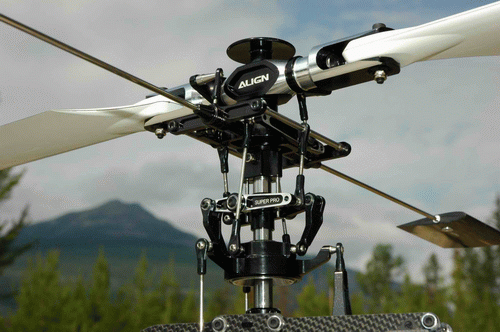 Hiller/Bell Mixed Rotor Head
The photo above shows a typical Hiller/Bell Mixed rotor head. Note the pushrods from the swashplate are attached to the flybar Bell mixers, not directly to the main rotor blade mounts as they are on Bell heads. This dampens or absorbs the sensitivity of the rotor disc to a controllable level mechanically without the need for electronic stabilization.
So What's With The Hiller???
Great question... In the very early days of radio controlled helicopters, the flybar head type was called plain old Hiller.
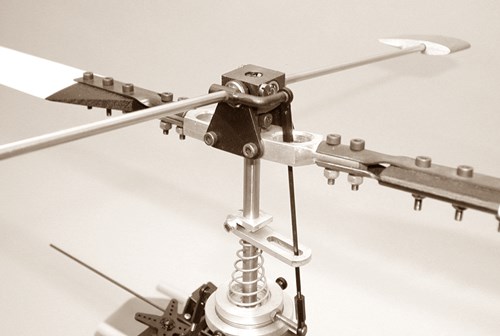 Hiller Head
Basically the pushrod/s from the swashplate went to only the flybar, and then the flybar alone as it "teetered" from the swash tilt would impart the cyclic pitch changes to the main rotor blades.
There were no mixing arms involved at all and all main rotor blade movement was directly caused by flybar movement. This gave very mushy and slow cyclic response, but it worked and was stable (as stable as could be expected back then). Hiller only heads as you can see were fairly simple mechanically speaking, and that along with the stability is why they were used in the early years of our hobby.
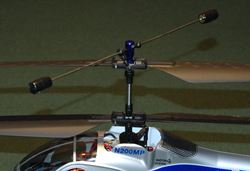
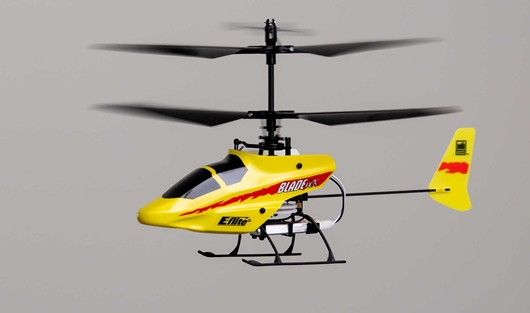
In fact, you can still find a very basic type of Hiller head being used today on the upper rotor head of most if not all micro coaxial RC helicopters as shown in this photo.
The upper head on these little rascals is only responsible for stabilization and has no cyclic control. The lower rotor imparts cyclic using a pure Bell head. In other words, it's not really a full blown Hiller head on the top rotor that also allows cyclic input; but none the less, the basic stabilization principles of a flybared Hiller head remains the same as they did 50 years ago. So in a very real sense, micro coaxial RC helicopters also use Bell/Hiller mixing, but they achieve it by using both head types (Bell on the bottom, Hiller on the top) instead of combining/mixing them.
As the hobby progressed, Hiller/Bell mixing was introduced to combine the stability of a Hiller Head, with the response of a Bell head. This type of rotor head remained the popular bullet proof norm for well over 20 years until electronic flybarless stabilization systems started being introduced and went more or less main stream around 2010-2011.
Most higher end flybared collective pitch RC helicopters with Bell/Hiller mixing also give you the ability to adjust the amount of mixing using different spacing/pushrod geometry on the mixing arms to allow for more or less flybar dampening. This way you can shift the cyclic response toward the aggressive side of a pure Bell head, or slow it down towards the pure Hiller head type of response.


Need Heli Help?
- Getting into the hobby but have no one to help you?
- Are you feeling overwhelmed & confused?
- Are you tired of wasting time seeking partial and conflicting information?
- Don't understand the maze of RC heli setup fundamentals?
- Is that sickening feeling after crashing turning you off the hobby?
- Are you simply ready to give up?
My RC Helicopter eBooks will help you with those exact problems. Grab your copies today.
Click Here For More Information

Click Here For More Information
Click Here For More Information
 Interested In RC Airplanes Too? Save Money With The Beginner's Combo Package
Recent Articles


-
Blade mCX Anniversary Special Edition RC Helicopter Review
May 29, 25 07:30 PM
 The Blade mCX Anniversary Special Edition remains to be one of the best micro coaxial RC helicopters of all time!
 -
RC Helicopter For Kids & Beginners - Making An Informed Purchase
May 29, 25 02:47 PM
 How To Choose The Best RC Helicopter For Kids & Beginners in 2025
 -
RC Helicopter Lift Fully Explained
May 29, 25 01:29 PM
 Are you wondering how RC helicopter lift is generated? Is your helicopter not lifting off and you have no idea why? Let's look at the two ways lift is generated on an RC heli. You will then know what…