Nitro Fuel Tank Tips For A Reliable Running Engine & RC Helicopter
by John Salt
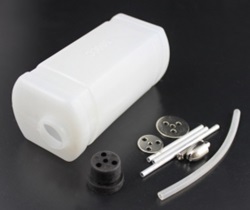 Nitro Fuel Tank And Hardware
Nitro RC Helicopters or any nitro model uses nitro/glow fuel. Naturally, we need a fuel tank to contain the nitro fuel, simple right?
Yep, but there are things to consider like size and placement of your fuel tank, internal part maintenance, venting, pressurization, refueling and filtering. That will all be covered here.
I should mention that all information on this nitro RC fuel tank page will also apply to gas/petrol powered RC helicopter fuel tanks; with the important exception of the fuel line used because nitro/glow fuel line (silicone) will swell and degrade if used in gas/petrol applications (Tygon fuel line is usually used for gas powered models). Gaskets and seals if any are used will also differ between the two fuel types; silicone is used with nitro/glow fuel, Nitrile synthetic rubber is used with gas/petrol fuel.
Regardless of fuel type, most model engine fuel tanks are generally made from polyethylene plastic that is opaque so you can easily keep an eye on your fuel level; not only to see when the tank is getting full while refueling, but also nearing empty while flying.
I can’t think of one nitro or gas RC helicopter kit that doesn’t come with the fuel tank and required fuel tank hardware as part of the kit; so you shouldn’t have to purchase any of that stuff separately.
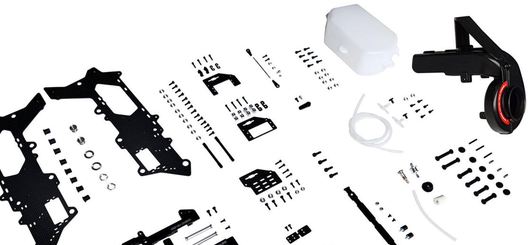 Nitro RC Helicopter Kits Usually Include The Fuel Tank & Tank Hardware
If you do however, or have to replace a tank and you have some size wiggle room, make sure you get a tank big enough to give you at minimum a 10 minute flight.
All nitro engine instructions will specify their fuel consumption generally indicated in ounces or milliliters per minute; so it's an easy matter of calculating the size of fuel tank you need to get a 10 min flight or so.
I'm of the opinion to get the biggest fuel tank you can fit into your nitro RC helicopter; assuming you have that option and that it doesn’t throw your center of gravity off too much. When you are learning to hover or just flying around, you want long flight times. Once you get more advanced and want a lighter heli over longer flight times to perform 3D tricks – simply don’t fill the tank up as much.
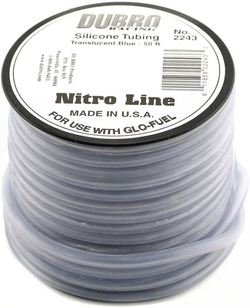
Your RC helicopter kit should also come with enough nitro/glow fuel safe silicone fuel line to connect the fuel tank to the engine and exhaust, but it never hurts to have more on hand if you make a length cut mistake or as it simply wears out over time.
I personally check the clunk line inside the tank every two years but some suggest once a year. The silicone fuel line in the tank does required replacement from time to because it's often submerged in fuel and tends to get brittle over time so the clunk in the tank will not move around as easily as it should or the line cracks (more on nitro fuel tank clunks in a bit).
Nitro Fuel Tank Placement
Another fuel tank item to consider when purchasing your nitro RC helicopter is where the fuel tank is located. The best location is directly under the main rotor shaft. If the fuel tank is centered under the main shaft, the lengthwise center of gravity (C.G.) of your helicopter won't change at all during flight as the fuel is used up.
Of course because of engine layouts and cooling fans/ducting, this ideal under the shaft tank placement is generally not possible and a compromise must be made.
If the tank is not right under the main rotor shaft it should at least be as close as possible. The further forward or behind the rotor shaft, the more you will notice the C.G. change throughout the flight as fuel is consumed.
Behind the main shaft is the better location if you have a choice because the helicopter's C.G. will get a little nose heavy as fuel is used up which is always better than a tail heavy C.G. on any RC helicopter!
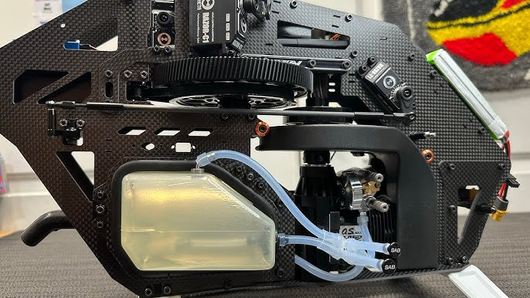 Nitro RC Helicopter Fuel Tank Placed As Close To Main Mast So C.G. Doesn't Change Much As Tank Empties.
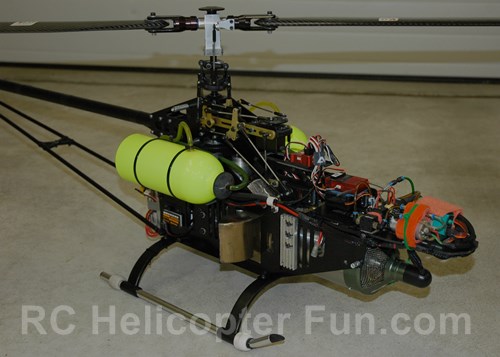 Turbine RC Helicopter Fuel Tank Placement On Both Sides Of Main Shaft To Maintain Correct CG
Thought I'd toss this photo in just as a point of interest while discussing fuel tank placement and C.G. My turbine powered Intrepid has two fuel tanks (the bright yellow cylinders) centered on both sides of the main shaft to maintain a neutral C.G. as the 1.8 liters of jet fuel (about 1.4 kg / 3 lbs) is consumed during a flight.
Nitro Fuel Tank Clunk
For those of you in the RC airplane world this is nothing new, but it might be a new term or idea for those of you with nitro RC cars, truck, or boats.
RC aircraft fly in many different attitudes – meaning pointing up, pointing down, on their sides, and upside down... not to mention the high G forces pulling the fuel to one side of the tank or the other.
If the fuel pick up was at a fixed location in the tank – say the lowest part of the tank like in an RC car – the aircraft would only get fuel when it's flying straight and level. Any hard banking or inverted flying would starve the engine of nitro fuel.
A very simple solution is the use of a short length of fuel line inside the fuel tank with a heavy weight on the end of the line called a "CLUNK". This fuel line and clunk will simply flop around inside the fuel tank whichever way gravity pulls on it - just like the fuel in the tank. In short, no matter what position the RC aircraft is in, the pick up end of the fuel tube (the clunk) in the tank is always submerged in fuel.
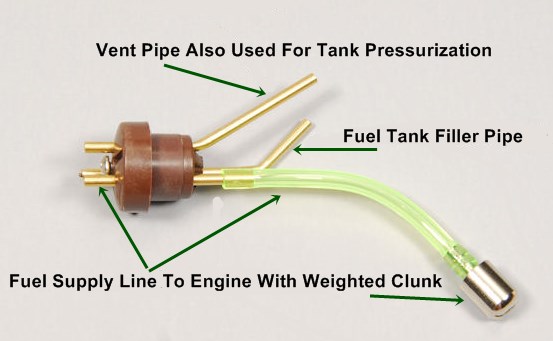 Nitro Fuel Tank Plumbing Components Including The "Clunk"
As already stated, this clunk, more specifically the fuel tube it is hooked up to inside the fuel tank should be checked for deterioration every year or two and the inside of the tank cleaned.
Pressurizing Your Nitro Fuel Tank
All RC nitro model engines benefit from a pressurized fuel tank but none to the extent of radio controlled helicopters.
A pressurized fuel tank will assure your nitro engine is always getting a stable fuel flow no matter what the fuel level.
Without pressurization, the fuel mixture may lean out enough during your flight to the point where the engine dies out.
This is the most common reason to use a pressurized nitro fuel tank with all nitro engines but for flying RC aircraft there are several more important reasons.
To understand these reasons, we must first understand a little bit about fuel tank venting.
All fuel tanks from your car to your lawnmower have vented fuel tanks, this not only allow excess gas pressure to escape, but also ensures the tank doesn’t build up a vacuum as fuel is drawn out by the engine – this is called vacuum lock. If fuel tanks were not vented, the fuel flow would simply stop – air must be allowed into the tank to take up the space the fuel once occupied.
The fuel vent is always placed at the highest point in the fuel tank; the obvious reason is to prevent the fuel from blocking and spilling out the vent. For most conventional fuel tanks like on a lawnmower, this vent is simply installed in the fuel filler cap – the highest point on the fuel tank.
Back to RC aircraft, especially ones that do aerobatics. If we are flying upside down or any position that causes the fuel to be higher than the vent hole, what happens? Yup, fuel blocks and may leak out the vent. If this condition remains, a vacuum will build in the fuel tank.
The engine will usually start running lean at this point. There is usually enough suction from the engine/carburetor to build enough of a vacuum inside the fuel tank that air will be drawn through the vent and prevent fuel leakage, but not always and it is possible the engine will be starved of fuel to the point it stops running (auto-rotation time).
It would take some time to create enough vacuum in the tank to starve the engine, but certainly less time than is experienced in sustained inverted flying or inverted hovers.
A pressurized tank solves these problems by pushing exhaust gas pressure into the vent. Even if the vent is covered by fuel, the exhaust pressure will prevent a vacuum from forming in the fuel tank or allow fuel to leak out the vent.
Pressurizing you nitro fuel tank is very easy and inexpensive. Most if not all nitro engine mufflers come with pressure fittings or a threaded hole that a pressure fitting can be screwed in to. Simply connect the pressure outlet on the muffler to the vent outlet on the fuel tank with some silicone fuel line - you now have a pressurized fuel tank.
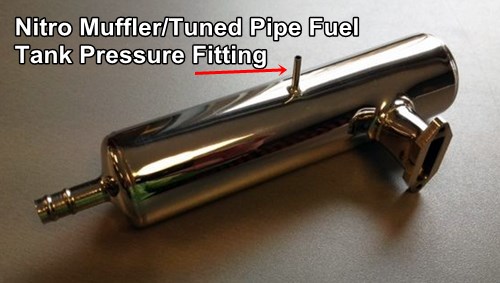 Typical Fuel Tank Pressure Fitting On Nitro Muffler/Tuned Pipe
This also ensures that no dust or dirt will be drawn into the fuel tank through the vent. Not a major concern for RC helis or RC airplanes, but a huge benefit for RC cars and RC trucks that run in dusty conditions.
I must point out that for a pressurized RC fuel tank to work, it must be a closed system. By this I mean the vent inlet from the muffler and the fuel outlet from the tank clunk line to the engine must be the only two functioning openings in the tank while the engine is running.
If you have a third separate fill vent tube, the system pressure will simply escape through that second vent. You can have a separate fill line; just make sure it is plugged off after filling or use a special fill valve that automatically closes after re-fueling.
Refueling Your Nitro Fuel Tank
I'm not going to go into the various devices used to add fuel to your tank such as pumping or using a nitro fuel squeeze bottle. I want to talk about the correct method of refueling your nitro RC helicopter, or any nitro / fuel powered model for that mater.
Never refuel through the vent in a closed system!
If you try to refuel through the single vent, you will be pressurizing the fuel tank with fuel as it fills up. As the pressure builds in the tank, the fuel will be forced through the clunk line into the engine's carburetor, and completely flood out your engine.
If you try to start an engine that is full of raw fuel, you run the risk of hydro locking the piston and bending the connecting rod or piston pin if you have a strong enough starter.
I've also rounded out a starting hex shaft once when an engine hydro-locked. If you do happen force a bunch of fuel into your nitro or gas engine, remove the glow or spark plug and spin the engine over with your starter until you blow all the raw fuel out though the plug hole.
Always refuel through the fuel supply line going to the engine carburetor or through a dedicated refueling line that can be closed off after refueling to prevent venting and spilling. Either method allows the air in the fuel tank to be displaced through the top vent as fuel enters during refueling but also allows tank pressurization after refueling while the engine is running.
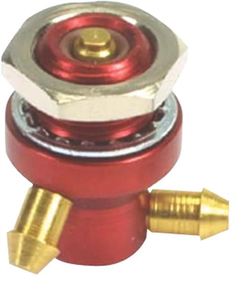
A popular filler valve used for this is the Du-Bro 335 Kwik Fill Valve.
I've used these on several models where it was difficult to get to the engine fuel line to refuel the tank and they work well.
They come with a special nozzle that you put on the end of your refueling pump or bottle fuel line that plugs into the face of the valve. The valve itself is mounted on some easily accessible part of your RC model through a hole and the nut on the face secures the valve in place.
When the nozzle is removed after refueling, the sprung valve automatically closes off so no fuel leaks and your tank pressurization will still be intact.
Just make sure you get the correct valve for the correct type of fuel (nitro vs. gas/petrol). The nitro/glow valve uses a silicone o-ring and the gas/petrol valve uses a nitrile o-ring.
Filtering Your Nitro Fuel
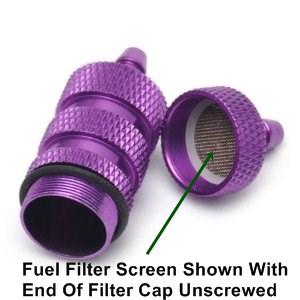
Speaking of re-fueling your nitro fuel tank, I highly recommend that you filter the fuel before it goes into the fuel tank. I call this "before tank filtering."
There are many RC fuel filters on the market. They are very simple in design using a very fine mesh screen inside; most can be opened up and cleaned as needed.
Our little nitro and gas engines have very small needle valve openings; it doesn’t take much to block them. Filtering your fuel before it even gets to your tank will ensure particulate free fuel inside your tank.
You could also place a fuel filter between the fuel tank and engine for even more filtering but I've never been a fan of this.
When using this filtering method, you will have to refuel by a separate refueling line or be sure to refuel between the tank and the filter. If you refuel from between the filter and the engine, you will back-flush and dirt in the filter into the fuel tank.
The other possibility if you refuel from the engine side, is any dirt the filter catches from your fuel pump or bottle will now be on the engine side of the filter and then get sucked into the carburetor, completely defeating the purpose of using the filter in the first place.
Lastly, a filter between the tank and engine introduces another point of flow problems causing a lean running engine or tuning difficulties if the filter is not checked/cleaned often. I personally find inline fuel filters to cause more problems than they prevent (the old risk to benefit ratio), but that decision is up to the pilot.
Regardless if you filter before the tank or after, some dirt will slowly accumulate inside the fuel tank over time (much slower if filtered before the tank). As mentioned, during my one or two year nitro fuel tank clunk line inspection/replacement, I'll also take a little extra time to clean out the tank with methyl alcohol (methanol) to remove any particulates that have settled out.
I just pour some methanol in, slosh it around in the tank and then dump it out, repeat if required. You don't have to worry about drying out the tank afterward as methanol is the main ingredient of nitro/glow fuel and also mixes fine with gas/petrol.
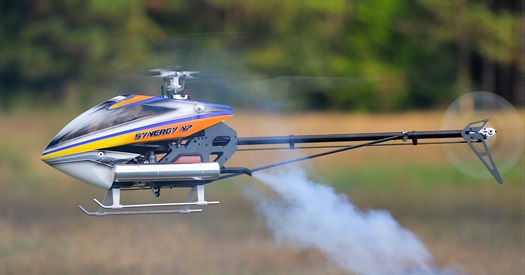 I still love the sound & smell of nitro!
That brings us to the end of the humble RC nitro fuel tank. I covered all the important items I wished I knew about fuel tanks when first getting into nitro, gas and turbine powered models, but if you think I left out something important or you have remaining questions, please let me know :)

 Having Fun With "The Wolf"
About the Author:
Hi, I'm John Salt (RC helicopter enthusiast and flying instructor). I've been building, flying, and helping people successfully take up the hobby of RC helicopters for over 35 years.
My goal is to take the mystery out of this amazing hobby so you can save time, spend less, while having more fun and success. Want to see my full story? Head over to my About Me Page.

Need Heli Help?
- Getting into the hobby but have no one to help you?
- Are you feeling overwhelmed & confused?
- Are you tired of wasting time seeking partial and conflicting information?
- Don't understand the maze of RC heli setup fundamentals?
- Is that sickening feeling after crashing turning you off the hobby?
- Are you simply ready to give up?
My RC Helicopter eBooks will help you with those exact problems. Grab your copies today.
Click Here For More Information

Click Here For More Information
Click Here For More Information
Recent Articles


-
Best LiPo Battery Brands - Price, Performance, Lifespan.
Sep 24, 26 02:10 PM
 You're looking for the best LiPo RC battery brand for the dollar while avoiding the hype and BS! Here are recommendations based on actual long term usage.
 -
What Makes OMPHobby RC Helicopters So Good & Should You Get One?
Aug 24, 26 03:01 PM
 OMPHobby RC Helicopters are designed to last! Easy to see, robust, impressive engineering, great parts support and much more.
 -
RC LiPo Battery Storage - Keep Your LiPo's Safe & Healthy
Jul 23, 26 07:51 PM
 Why is RC LiPo battery storage so important? Easy, it extends battery life saving you money plus increasing storage safety.