RC HELICOPTER MATERIAL HAS TO TAKE A LOT OF STRESS.
by John Salt
Choosing the correct RC Helicopter Material shouldn't cause you stress too.
Let's look at the common ones and figure out what is best for you.
A RC helicopter has to endure all kinds of stresses such as high and low frequency vibrations, heat, G-forces, centrifugal forces, hard landings... Okay you get the picture.
So you want your RC Heli material to be strong enough to withstand all that yet be light enough so your helicopter can actually fly (high strength to weight ratio in other words).
First off, when I am talking about RC helicopter material, I am referring to the material that the main frame and tail boom sections are made from, not the body/canopy.
Canopy materials are discussed in the Scale and Pod-and-Boom section.
The main frame is what holds and houses all the mechanical components of the helicopter such as the engine/motor, clutch, gear/belt drive systems, rotor shaft, bearing blocks, control mechanisms, electronics, servos, gyro/flybarless systems, and fuel tank or batteries. You know the “guts”.
The tail boom is the long section that attaches to the main mechanical section that of course has a tail rotor at the other end.
Aluminum RC Helicopter Material
 Aluminum RC Helicoper Frame
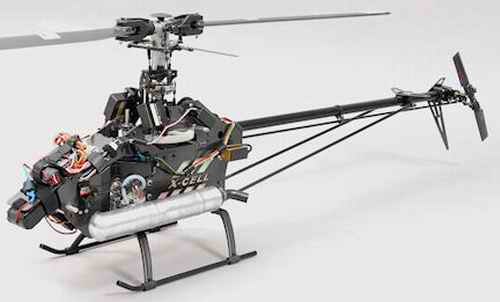
When I first took up the hobby in 1989, the only RC helicopter material we had was aluminum. Aluminum is strong and light, dissipates heat well, and is inexpensive. It is still a common material in use for both the main frame structures and tail boom sections of most nitro, gas, and turbine RC helicopters and a few larger electric ones. However, it tends to be too heavy for small and micro electric models.
Other than being too heavy for micro helis, aluminum has two other minor disadvantages. Over time it can develop stress cracks. This is more common with nitro engine helicopters because of the very high frequency vibrations associated with engines running at 15 to 18 thousand RPM. These cracks will usually occur where the engine is mounted to the side frames or at the starter shaft bearing block (if your heli uses this starting method).
The other problem that I have seen with aluminum is during a hard landing or crash; the frame structure can bend and go unnoticed. This would cause alignment issues, that if not discovered right away will lead to stress, wear, or catastrophic in flight failures.
Plastic RC Helicopter Frames
 Plastic RC Helicopter Frame
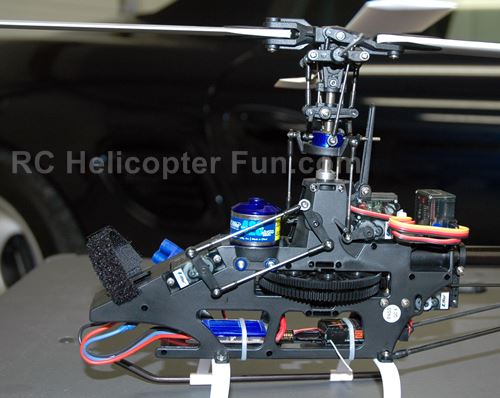
Plastic solves both these problems because it absorbs vibration much better, and instead of bending and staying bent, it will return to its original shape (unless it is bent past the point of no return and breaks).
Plastic is very inexpensive and relatively light for the amount of strength it provides. It doesn’t take heat well, but on an electric model that is not an issue. Most nitro engine setups with plastic frames use an aluminum portion where the engine mounts. This assembly is then mounted to the plastic side frames.
Plastic is not as strong as aluminum and is generally used on small and lower priced nitro models or electric helis. To the best of my knowledge, plastic has never been used on a gas or turbine model. It is simply not strong enough and flexes too much. Plastic is never used on tail booms for the same reasons. Tail booms are always made of aluminum or carbon fiber.
Fiberglass Frames
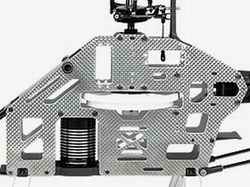 Fiberglass RC Helicopter Frame
Fiber Glass, also called glass fiber(GF) or "G10", is found on some mid to higher end machines while saving some coin. It offers many of the good characteristics that Carbon Fiber does. GF absorbs high/low frequency vibrations, is fuel and heat resistant, and most people like the look of it.
Fiber Glass frames are not as ridged as carbon fiber and weigh more, but for the average flier, they work well and cost less than the equivalent carbon fiber frame.
You can find fiberglass being used right from small birds up to huge turbine powered machines & scale specific frames. It works well with all fuel types and electric power options.
Carbon Fiber Frames
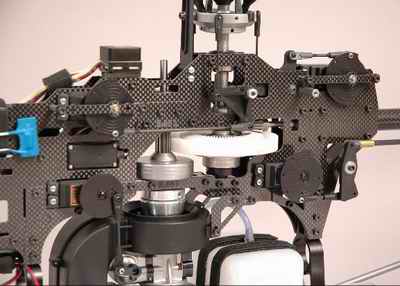 Carbon Fiber RC Helicopter Frame
Where would the world be with out Carbon Fiber? Yes, almost everything from fishing poles to jet aircraft have benefited from it, and the world of RC helicopters is no exception.
Carbon fiber seems to have been tailor made for our hobby. It is stronger and lighter than plastic, aluminum, & fiber glass; absorbs vibration better than aluminum, and handles heat and cold. It can be molded to be super stiff in one direction and flex in another direction.
For your first helicopter, it is probably not the best choice. Even though it is stronger than aluminum and fiber glass, it will still break in a bad crash and cost quite a bit more to replace.
That said, as the price of carbon fiber keeps coming down, it has become common place on entry level collective pitch birds such as the Trex 450 DFC Plus and will no doubt become the main material in RC helicopter construction – it is just so good for so many reasons.

As an Amazon Associate I earn from qualifying purchases.

Need Heli Help?
- Are you getting into the hobby and have no one to help you out?
- Are you feeling overwhelmed & confused?
- Are you tired of wasting time seeking partial and conflicting information?
- Is crashing due to not fully understanding helicopter setup turning you off the hobby?
- Are you simply ready to give up?
My RC Helicopter eBooks are here to help you with those exact problems.

Click Here For More Information

Click Here For More Information
Click Here For More Information
 Interested In RC Airplanes Too? Save Money With The Beginner's Combo Package
Recent Articles


-
OMPHobby RC Helicopters Let You Master The Skies
Apr 18, 24 07:21 PM
 Don't settle for anything less! OMPHobby RC Helicopters are built to last while taking your flying passion to a whole new level.
 -
Best Flybarless System In 2024 - Is There Such a Thing?
Apr 02, 24 09:08 PM
 Looking for the best flybarless system? Let's look at what's out there, pros & cons, features and pricing, to help you narrow your list.
 -
Learn How To Fly 3D Helicopter Aerobatics
Mar 15, 24 03:30 PM
 Want to learn how to fly 3D helicopter aerobatic maneuvers? Follow this skill building lesson plan to succeed.