E-flite's Blade mSR Review What Made It So Good?
by John Salt
With the Blade mSR (micro-single-rotor) and the mSRX , E-flite has finally done it - I have to eat crow now (just wish I knew the best way to cook it). For anyone who has spent time on my little heli site here, you know how much I dislike single rotor RC helicopters with electric tail motors, I rant on and on about how horrible and vague the tail control was, is, and as far as I was concerned, always would be.
Update: Both the mSR & mSRx have been discontinued but have been replaced with the mSR S.
Well, E-flite must have wanted to prove me and many others wrong when they were designing the mSR.
YES - this is finally an electric tail motor heli that works, and works well. The tail holding ability and response is amazing not to mention overall flight performance. The Blade mSR is going to be a hotter product then the Blade mCX in all areas, most noticeably flight performance.
The flybarless version of the mSR (called the mSR X) is now available. I have more info on it at the bottom of the page and the link above will take you to my review on it.
Blade mSR's Tail Rotor Actually Works!
So why is this a motor driven tail that actually works
well and is making me re-evaluate every rotten thing I have ever said
about electric tail motors? There are two main reasons...
First off, the Blade mSR heli is very small and light, as is the rotating mass of the main rotors. This means the reactive torque produced by the main rotors is minimal compared to a larger heavier motor driven tail machine like the CP-Pro.
The low torque inertia means the electric tail motor doesn't have to work as hard to counteract that torque and it can use a very small tail rotor blade to compensate for it.
This also helps keep that tail motor from burning out in short order - a problem that has plagued electric tail birds since they were first introduced.
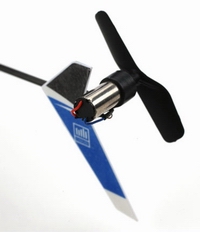
Then there is the tail rotor motor itself. Since the tail rotor blade is so small with almost no mass, the motor can directly drive the tail rotor blade with no need for speed reduction gearing.
The result of this direct drive is fast and instantaneous tail rotor speed adjustments. Add to that a very fast accelerating and decelerating coreless tail motor and you get the ultra fast tail response to finally be able to keep up with the gyro correction.
In short - tail holding and control that is almost as good as a belt or shaft driven tail rotor with variable pitch paired with a good gyro and fast tail servo. Now remember, this is still a motor driven tail and any sudden full power throttle command will induce torque yaw, perhaps up to a 130 degree deviation in heading if you go from zero to full power - not the way any of us should be flying, but I had to try for testing purposes.
Under these extreme full power, full torque conditions is the only time the Blade mSR will give you a marginal idea how all other electric tail motors behave and fail when it comes to good tail holding authority. Tail holding authority can be further improved on the mSR by keeping your throttle stick commands smooth.
Using a computerized Spektrum or JR radio to shallow out the throttle curve in the 25-75 percent stick range will further improve tail holding authority, throttle response, and allow very precise lift control with the blade mSR.
You can hear the little coreless tail motor on the mSR working hard to keep things in check and is one more example of how hard electric tail motors even on a heli of this size have to work. Despite the work load, the efficient coreless motor remains cool during back to back flights. After hundreds of test flights on my blade mSR, the tail motor is still functioning 100%. A tail motor that works, runs cool, keeps up to the gyro, and doesn't burn out on a weekly basis - how nice!
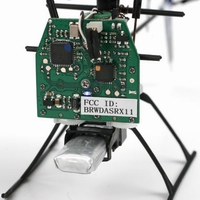
Speaking of the gyro, the Blade mSR incorporates a rate gyro in the 5-in-1 unit. The 5-in-1 actually looks very similar to the one used on the Blade mCX and mCX S300 .
The 5-in-1 unit places all the circuitry on one board to save space and weight. The DSM2 2.4 GHz receiver, 2 linear servos to drive the X/Y axis of the swash plate, ESC motor controller/mixer, and of course the gryo. This is the true heart of both the mCX/S300 helicopters and E-flite's mSR helicopter.
In fact, much of this little heli seems to share mCX/S300 DNA. Most importantly to me is the durability. Those of you with mCX's or S300's know how much abuse they can take thanks to the flexible parts and ultra light weight, the mSR is no different.
Another example of shared DNA is the battery. The same little 3.7 volt LiPo battery is used meaning if you already have a mCX, mCX S300, or the super hot ParkZone Sukhoi fixed wing park flier, you could use the same batteries for all 4 birds.
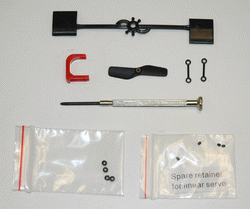
As is usual with all of E-flites micro helis, a nice little accessory set is included with each mSR. This package contains a spare flybar, tail rotor, canopy grommets, linear servo shaft retainers, two swash to flybar pushrods, along with a Phillips screw driver and a head alignment tool.
Blade mSR Unbelievable Performance & Stability

Flying the Blade mSR outside in calm conditions - too much fun!
While some of the mCX's DNA is shared, when it comes to performance, the similarities end. The Blade mSR is fast!!! Overall flight speed is truly impressive in all directions not to mention the dizzying pirouette rates. While this little heli can be flown indoors; outside or in a gymnasium is where it will shine.
Flying in a slight wind is possible, although control is erratic as the wind tosses this 1 ounce birdie around. It is a fun test of skills to push the performance envelope outdoors in wind with some absolutely blistering downwind speeds achieved and I somehow once managed to get inverted before losing all control.
If good control is what you are after, certainly not the best environment for this little gem and I don't really recommend flying it in those conditions; but flying over soft grass is pretty safe to try it out on. I had some pretty hard impacts that just blew the canopy off with no damage. Pop it back on and you're off
Even with the outstanding performance, due to the flybar configuration and the way the Bell mixing has been set up, this is the first hobby grade single rotor heli on the market that is almost as stable as a micro coaxial . That is a tall order once again showing E-flite really is leading the market in innovation when it comes to small electric affordable RC fun.
This is where some may not like the mSR, it is just too stable if you are looking for a good platform for practicing and learning how to fly a collective pitch single rotor RC helicopter. Now there are ways to increase the sensitivity and reduce the stability, especially if you are binding your mSR to a computerized Spektrum or Jr Radio.
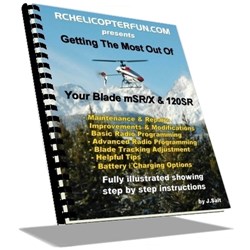
I have an eBook that goes over these settings and much more. Just click on the picture of the guide to the right to find out more about what's inside.
I feel in this "sensitive mode" the mSR is probably the perfect indoor nose in hovering practice ship. I have heard this sentiment from other mSR owners who have contacted me relaying the blade mSR has helped them immensely gain nose in hovering skills and confidence for their collective pitch machines better and faster than any other training method, including hours on a good flight simulator.
The Blade mSR will also teach you to coordinate your turns with both a tail rotor and left or right cyclic command to achieve a good solid banking turn with much better results then a micro coaxial could duplicate. Of course, as soon as things get a little out of hand, the flybar will take over and pull the heli back into a level configuration and does so with a fair amount of authority.
This is the only flight characteristic of the Blade mSR I am not a fan of. The flybar correction is very intense and for lack of a better description, makes the mSR behave like it is the weight at the end of a string. The mSR behaves like a pendulum in other words when the self correcting properties of the flybar are put to the test recovering from steep and fast flight.
This is not a bad thing for someone just starting out with the mSR and for a heli that moves so quickly, it is pretty much the only way a total correction from that amount of velocity could be achieved. It does take a bit to get used to however...
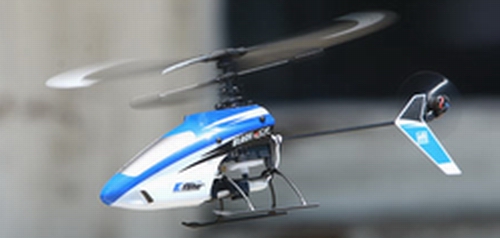
Blade mSR - Tame or Insane
Here's a neat little feature the folks at E-flite have come up with. Out of the box, the Blade mSR is set up for fairly gentle cyclic control . Once you get a feeling for the controls and really want to push the performance envelope this small bird is capable of, you can make a small adjustment to wring out more cyclic throw.
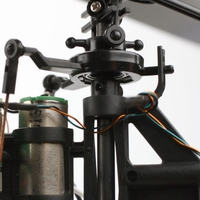
The upper swash has two different length ball outsets. With the two bell mixing ball links on the inner balls, the cyclic response will be more docile.
Snapping those two ball links off the inner swash balls and moving them to the outset balls will increase cyclic travel; resulting in some pretty insane flying that no other micro electric heli this small can even come close to.
Speaking of Tame or Insane... There is a very important section in the instruction manual (page 23 or page 19 on newer manuals) that I totally browsed over in my haste to go flying the first day I got my mSR.
It has to do with channel 5 settings and talks about the reduction in cyclic servo throw (both aileron and elevator) by about 15% if channel 5 servo direction is not set correctly, or is not turned on and set to 100% of travel range. In short it is like turning on elevator and aileron dual rates if channel 5 is off or set to any value lower than 100% in the on position.
15% doesn't seem like much right? Well, when you have the pushrods on the furthest ball outsets and trying to get every bit of performance possible out of your mSR. Having channel 5 turned off will reduce flight speed by about 50%.
I was really getting bummed that my mSR was not flying near as quick as it should have been and if I would have paid more attention to the instructions, I could have saved myself hours trying to figure out why.
Blade mSR Specifications
- Length: 190mm (7.5 inches)
- Height: 90mm (3.5 inches)
- Main Rotor Diameter: 180mm (7.0 inches)
- Weight with Battery: 28g (1 oz)
- Main Motor: Coreless installed
- Tail Motor: Coreless installed
- Battery: 120mAh - 14C - 1cell - 3.7V LiPo (comes with 2)
- Charger: Celectra 4 port with 6V 1.5A AC adapter (can also be powered with 4 D-cell batteries)
- Transmitter (RTF version only): 4 Channel, DSM2 2.4 GHz model # MLP4DSM
- OnBoard Electronics: 5-in-1 unit (installed)
Final Thoughts
Well, as you can guess by my drooling, I feel this is the perfect in-between step from micro coaxial to single rotor collective pitch if you are uncertain or still a little intimated by that next fun step. On the other end of the skill set, all levels of RC heli pilots will love this little bird for the insane indoor fun it provides for the low cost outlay.

Need Heli Help?
- Getting into the hobby but have no one to help you?
- Are you feeling overwhelmed & confused?
- Are you tired of wasting time seeking partial and conflicting information?
- Don't understand the maze of RC heli setup fundamentals?
- Is that sickening feeling after crashing turning you off the hobby?
- Are you simply ready to give up?
My RC Helicopter eBooks will help you with those exact problems. Grab your copies today.
Click Here For More Information

Click Here For More Information
Click Here For More Information
Recent Articles


-
How Do RC Helicopter Controls Work
Jan 27, 26 01:28 PM
 Let's learn all about RC helicopter controls, both on the helicopter and the transmitter; along with basic, yet important helicopter flight principles.
 -
RC Helicopter e Books To Help You Succeed In The Hobby
Dec 18, 25 08:05 PM
 New to the hobby? Self learning & need help? Frustrated? These RC helicopter e Books will help, while cutting your learning time down substantially.
 -
Toy Helicopters - Which offer the best value & fun in 2026?
Nov 25, 25 06:23 PM
 With so many toy helicopters on the market in 2026, which are worth your time and money? Here are my top recommendations.