Choosing The Best RC Helicopter Engine
by John Salt
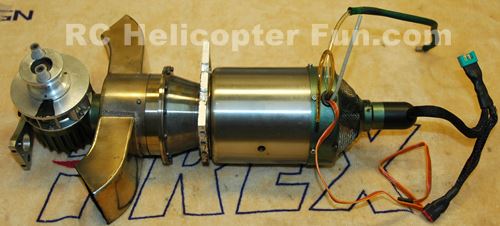 RC Helicopter Jet Turbine Engine
The RC helicopter engine/power plant... Probably the very first choice you want to make when deciding on the best RC helicopter for you.
By deciding this right now, your list is narrowed substantially and makes your RC helicopter purchase decision much easier.
To make the best RC heli engine choice, let’s look at the pros and cons of each of the four power options available today.
There is no candidate best power choice. Each have strengths & weaknesses, pros & cons; and what you eventually decide to purchase will be based on what your needs are.
The following discussion is to point out different advantages and disadvantages of each RC helicopter engine power option.
If you want detailed explanations of each type of heli, simply click on the specific links for a more in depth examination.
Electric Powered RC Helicopters
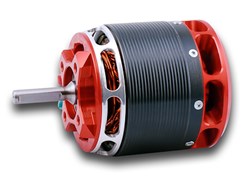
Advantages:
- Easiest to set up. No difficult tuning of carburetors, fuel systems or exhaust systems.
- Less likely to cut out in mid flight due to fuel/air mixture or ignition problems that plague all fuel powered models (turbine not so much).
- Electric Motors are pretty close to vibration free (no reciprocating piston or exhaust pulse).
- Power to weight ratios these days are better than any other power source - yes even turbine!
- Lower long term operational costs (no fuel to purchase).
- Flying weight and center of gravity (CG) don't change throughout the flight as they do with fuel powered models.
- Much quieter. Some municipalities have strict noise regulations and an electric RC helicopter may be your only option if you wish to fly in a field close to home.
- No messy oil residue all over the helicopter and surrounding area.
- Easy to start and stop. No special starting equipment such as glow plug power panels and starter systems.
- Can be flown indoors with no poisonous exhaust being produced.
- Less maintenance intensive than fuel powered.
- Better for the environment.
Disadvantages:
- Size for size - higher initial purchase costs over nitro because large capacity lithium batteries although coming down in price are still expensive.
- Large lithium batteries can be dangerous or easily ruined if not cared for properly.
- If flown hard, flight times can be short.
- If you don’t want to wait between flights to cool and charge your battery, you will need at least several extra batteries, adding to the cost (I personally find 6 packs adequate).
- Even if you have several extra batteries, you may (if you fly very aggressively) still have to wait 15 minutes or so between flights to let the motor and electronic speed controller cool down (dependent on quality of motor and ESC).
- Special charging and power supply equipment required - the larger the LiPo's the more charging power you generally need.
- Some planning ahead is required if you want to have all your battery packs charged up and ready for a day out at the flying field. This is totally dependent on how many helis you have, how many battery packs you have, and how much charging power you have.
Nitro Powered RC Helicopters
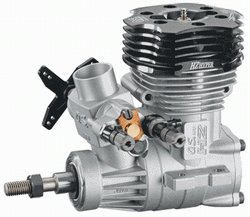
Advantages:
- Refuel and go... no waiting around between flights to charge batteries or wait for electric motors and speed controllers to cool down.
- Proven design and long life expectancy.
- Generally less expensive than an equal sized electric model when you take into account the expense of high capacity RC LiPo batteries.
- The most crash proof of all power options... nitro engines are almost indestructible.
- I for one love the smell of nitro exhaust - but that is a subjective point.
- Noise – some of us love the high pitched sound of a nitro engine turning at 17,000 rpm.
Disadvantages:
- Noisy – some hate that high pitched noise. Nitro engines are very noisy only to be topped (sometimes) by turbine engines in decibels produced.
- Messy - Nitro fuel is around 20% oil, and that fine oil mist in the exhaust gets everywhere. It is for most people the very worst aspect of nitro engine power.
- Fuel tank placement and how it affects the center of gravity is important.
- Hard to tune and set up correctly... especially for people with no prior nitro model engine experience. Can stop running in middle of flight if mixture is not right, fuel is contaminated, fuel supply/tank vent gets blocked, or glow plug fails.
- Glow fuel is only available at hobby shops and because it is classified as a hazardous material is expensive and difficult to ship.
- Higher long term operating costs over electric, gas RC helicopters, and even turbine. Nitro engines are thirsty and nitro glow fuel costs much more than gasoline or JET A. You also have to replace glow plugs from time to time.
- Vibration prone starting shafts and fans , or inconvenient belt start systems.
- Additional special starting equipment needed such as electric starters and glow plug drivers/power panels (built-in or external).
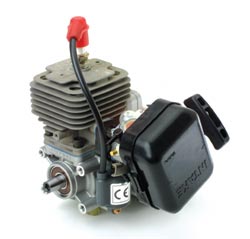
Gas Powered RC Helicopters
Advantages:
- Not as messy as a nitro RC helicopter engine – low oil to fuel mix ratio means most of the oil gets burnt in the combustion process.
- Runs at lower RPM so it is not as noisy and doesn’t produce as much high frequency vibration as a nitro engine.
- Runs on ordinary gasoline and 2-cycle engine oil that can be purchased anywhere.
- Usually easier to start.
- Long life expectancy.
- Less costly to operate than a nitro heli.
- Gasoline is readily available anywhere, and costs much less than nitro fuel.
- Gas engines don't use as much fuel as nitro engines meaning longer flying times or smaller fuel tanks than an equivalent powered nitro engine.
- Quite big & heavy providing more realistic helicopter flight characteristics.
- Flight times can be impressive (up to 30 minutes on some models with large tanks if not flown hard).
Disadvantages:
- Lowest power to weight ratio of all power options (not suitable for hard/extreme 3D aerobatics).
- Limited selection of gas RC helicopter models.
- Higher price than electric or nitro because the helicopters are usually larger and economy of scale production is not as good since there are less of them manufactured.
- Lager reciprocating piston mass produces strong lower frequency vibrations.
- High voltage ignition and spark plugs produce radio interference - generally not an issue with PCM or 2.4GHz spread spectrum radios.
- Large, heavy models means more damage usually occurs in a crash.
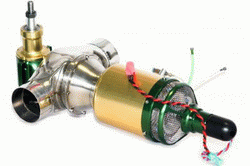
Turbine Powered RC Helicopters
Advantages:
- Realism... it doesn’t get much more real than this.
- Very reliable power that is not nearly as prone to cutting out and no tuning hassles since the turbine's engine computer (FADEC) is very good at keeping it running perfectly. In my experience, I have found turbine power as reliable as electric power.
- Very little if any engine vibration - pretty much as good as electric due to no exhaust pulse or reciprocating piston mass.
- Noise and smell! Yup, they’re noisy - loudest of the bunch, but what a great noise. The sweet smell of jet exhaust is hard to beat.
- Heat waves blowing out the exhaust look great.
- Powerful enough for very large RC helicopters – scale or pod & boom.
- Like gas powered, they are big and heavy giving realistic flight characteristics.
- The challenges and rewards are very high.
- Lots of neat new stuff to learn about how a turbine engine works and runs.
Disadvantages:
- Turbine Engines are expensive.
- Only a few companies provide turbine specific helicopter kits, and turbine engines. Parts availability, waiting time, and depending where you live - import fees are generally all issues.
- Turbine bearing replacement every 50 to 80 hours usually requiring sending the engine back to the factory for them to balance the turbine and compressor assembly properly after bearing replacement. See my own turbine overall experience here.
- Most complicated with many turbine specific systems on-board the aircraft.
- Somewhat maintenance intensive (not much more than gas or nitro).
- Higher operating costs compared to equivalent sized gas powered models, fuel costs less than nitro however.
- Heavy damage costs even in light crashes or hard landings.
- Although powerful, turbine heli engines are heavy so the power to weight ratio of turbine powered helicopters is actually not much better than that of gas powered. Hard/extreme 3D aerobatics not possible.
- Fire hazard. Can catch on fire if crashed and can ignite dry grass when starting, taking off, or landing on dry grass.
RC Helicopter Engine Choice For Beginners
For all beginners the best RC helicopter engine power option is either going to be electric or nitro; so concentrate on those two and weigh the pros and cons carefully. For ease of use, availability, and hassle free operation, electric really is the clear choice.
If you are experienced with nitro or electric helicopters already, your RC helicopter engine choice might be a gas powered heli.
The main reason most people get into Gas RC helicopter engines is to reduce the operation cost of using nitro fuel, eliminate the hassles of getting nitro fuel, and saying goodbye once and for all to messy nitro goo.
Many also make the switch to gas because they want to start flying very large pod and boom or scale RC helicopters, but don’t want the very high costs and complexity that go along with turbine power. That said, large electric RC helis are now a reality as well, but the multiple LiPo batteries required for them pushes the costs up a fair amount. Two stroke gas engines are simply the most economical power choice for large birds.
Finally – if you are a very competent RC heli builder/flier and want the ultimate in mechanical complexity & realism, a turbine engine powered RC helicopter is one of the most satisfying projects to undertake.

As an Amazon Associate I earn from qualifying purchases.

Need Heli Help?
- Are you getting into the hobby and have no one to help you out?
- Are you feeling overwhelmed & confused?
- Are you tired of wasting time seeking partial and conflicting information?
- Is crashing due to not fully understanding helicopter setup turning you off the hobby?
- Are you simply ready to give up?
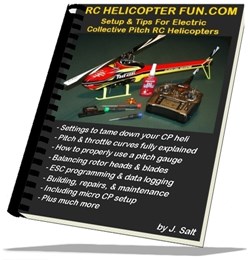
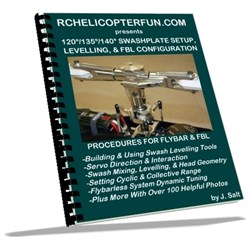
My RC Helicopter eBooks are here to help you with those exact problems.
Click Here For More Information

Click Here For More Information
Click Here For More Information
 Interested In RC Airplanes Too? Save Money With The Beginner's Combo Package
Recent Articles


-
OMPHobby RC Helicopters Let You Master The Skies
Apr 18, 24 07:21 PM
 Don't settle for anything less! OMPHobby RC Helicopters are built to last while taking your flying passion to a whole new level.
 -
Best Flybarless System In 2024 - Is There Such a Thing?
Apr 02, 24 09:08 PM
 Looking for the best flybarless system? Let's look at what's out there, pros & cons, features and pricing, to help you narrow your list.
 -
Learn How To Fly 3D Helicopter Aerobatics
Mar 15, 24 03:30 PM
 Want to learn how to fly 3D helicopter aerobatic maneuvers? Follow this skill building lesson plan to succeed.